
Forage Friday #88 Privet – Toxic

Hello Friends! Tonight’s Feature Image is titled “Privet Berries 113020” and is available for purchase by clicking the thumbnail and reaching out to me on the contact page.

Please remember that Forage Friday is presented as trivia and not to be mistaken for medical advice. In addition, Privet is a toxic plant that in a survival situation could produce symptoms that are counterproductive to survival.

Folk tales are full of forbidden fruit archetypes. The poison apple is a classic. And although these cautionary tales have a symbolic reference to morality the dangers of a fruit that looks yummy but could wind up costing a unwise traveler their life is very real. Privet is just such a plant. In several of plant forums I belong to there’s always a novice that posts a picture of beautiful berries that are available at a time of year when there’s not much to forage on. Of course those of us have learned about Privet are quick to point out that it is a toxic plant and sometimes that warning is given with exuberance that can come off as being harsh. I like to believe that’s only because they care and are frightened for the poster. It’s nothing to be embarrassed about. We’re all a novice in some areas. According to Wikipedia, Privet is a mild toxin under normal circumstances. Symptoms include abdominal pain, nausea and vomiting and one online source advises to seek medical attention if more than 5 berries are consumed. They go on to warn that for some people just contact with the leaves and berries can cause rash and that smelling the flowers causes respiratory distress. Hence the extra caution in tonight’s disclaimer. I presume that the medical professionals would treat the poison with pumping the stomach and activated charcoal. Because the modern world has such wonderful equipment and training it’s likely that the victim would survive. But a lot of people are exploring the world of foraging in relation to wilderness survival. Food is actually the lowest priority in a sudden survival situation. The first priority being shelter, then fire, then water and food is last. The higher priorities will usually require a bit of effort. A person suffering from the symptoms of Privet poisoning will not be as capable of doing the physical work needed to build shelter and gather firewood and diarrhea will cause dehydration making the need for water even more urgent.
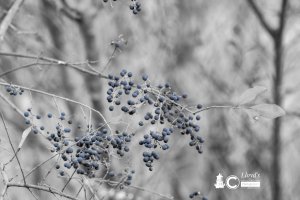
Image Titled “Privet Berries 113020bw” and shows the color of the berries.

The confusion over the ediblilty of Privet Berries is understandable. In nature we see a lot of blue and purple berries that are edible. Our minds automatically associate those colors with things like grapes, blackberries, blueberries and elderberries. So naturally we see these colors and our reflexes are to expect the same pleasant experience.

Wikipedia and other sources also say that private is used in traditional Chinese medicine. The leaves and inner bark are used to treat diarrhea, ulcers chapped lips and sore throat. Skin problems are treated by using it to wash the area. But I also read that warning about how contact with the foliage causes a reaction.

In closing thoughts the two biggest things to remember are that it’s good to get a positive ID so never be afraid to ask before you try a new plant and remember that just because your instincts tell you that a plant looks good to eat doesn’t mean you’re instincts are right.

That’s it for the first Forage Friday post of 2021.

Good night friends and be blessed throughout your days.

Hey Friends! Just a quick reminder that Lloyds Lens Photography is available for portraits!

To book me simply reach out using the Contact Page and we’ll set a date. If you’re within a 50 mile radius of Summersville West Virginia all travel fees are waived.

If you would like to Follow me on Facebook the web address is

https://www.facebook.com/aviewfromthelens/

If you’re enjoying my blog and don’t want to miss a post then you can sign up for email alerts on my website.

https://lloydslensphotographyllc.com/

Have you checked out the Zazzle Store?

I’m now using Zazzle to fulfil orders. What this means for you is a secure way to place an order, discount codes & a broader product selection! Simplymessage me on Facebookoruse the contact form on my websiteand tell me which image you want and I’ll reply with a direct link to where you can place the order.

Clicking on the photo takes you tohttps://www.zazzle.com/lloydslensphotos?rf=238248269630914251

Lastly, all of the photos and writings are my original work unless otherwise specified and are not to be copied or reproduced without expressed written permission from the photographer

Thank you again for your support of my page!

Forage Friday #87 Maples

Hello Friends! Tonight’s Feature Image is titled “October’s Flame 102220” and is available for purchase by clicking the thumbnail and reaching out to me on the contact page.

Please remember that Forage Friday is presented as trivia and not to be mistaken for medical advice.

I’m completely convinced that there’s no finer breakfast aroma in cold weather than that of warm maple syrup, Buckwheat pancakes and a side of bacon. In fact, it’s my firm belief that the only way to improve bacon is when that syrup runs off the pancakes and gets on the bacon. Of course it was a staple of our ancestors who needed that calorie count to get through the morning chores and today it’s common for the syrup to come from a farm. But in the old days true maple syrup involved quite a bit of work. It takes a whopping 40 gallons of sap to make a single gallon of syrup! Today we see tubes running through a cultivated forest with filters and valves to control the flow into collection vats. The sap isn’t cooked but it is evaporated and condensed into the gooey sweetness we enjoy today. The system has to be inspected constantly for air bubbles and impurities. Even with all the modern technology and techniques it’s a huge amount of work. But in the old days everything was done with a tap and a bucket. A family that just wanted a little something to sweeten with or to make special candies for the holidays had to invest a tremendous amount energy for a relatively small reward. However, if one wanted to put in the effort maple syrup can be foraged.

First, we need the right kind of maple for best results. Syrup can actually be made from any maple tree however the concentration of sugar means that for the red maples you have more water and therefore more energy has to go into collecting larger amounts of sap that will be heated for a longer period of time. We’d also need to consider how we heat the sap. Heating as much as 60 gallons of sap for a red maple based syrup means that much more fuel, gas or electric and still would only produce one gallon of syrup. So sugar maples are preferred. When the leaves are on there is a trick that I was taught in a dendrology course. Sugar is spelled with a U and sugar maple leaves have a U shape in the creases of the leaves.

Sugar maples are not always yellow in fall but normally do have a U in crease of the leaves. Both the yellow leaves and the orange leaves in tonight’s Feature Image are sugar maples.

Sugar maples also tend to have brown or tan twigs where the red maples tend to be red. Red maples have a V shape in the creases.

Red Maple leaves showing the characteristic V shaped creases and red twigs. Notice also that the leaves on this tree are both red an yellow.

I’ve never made maple syrup but I imagine that the process is pretty close to molasses. A large pan is filled with sap and low heat is used to evaporate the water out of the liquid while impurities are skimmed off. For a better look at that process check out the article on Making Molasses from fall 2019. It’s a time consuming process and hot working conditions to do it right but it’s far superior to the “Table Syrup” or “Pancake Syrup” sold in massive quantities at big box stores. Which often nothing more than maple flavored corn syrup with caramel food coloring. If the label lists any ingredients other than maple syrup then it’s not maple syrup. Fortunately for those of us who don’t have the time to invest in foraging our own maple syrup an entire cottage industry has sprung up based on small scale producers who are insistent on only selling the real thing.

Maple seeds are often something asked about when it comes foraging. They are available in massive quantities in the Appalachian Forest so it makes sense that someone would be interested in taking advantage of them. Here’s where we need to examine the definition of “edible plant”. Are maple seeds toxic? No. But according to Tom Brown Jr they’re only edible if you’re willing to grind them up and slow cook them for hours because they are so hard.

There are some medicinal qualities listed on the internet for sugar maple. The information is centered around the inner bark and as expected it’s said to aid in treating diarrhea ( probably due to tannins found in most trees. ) and in a cough syrup. The inner bark was used to treat sore eyes as well.

Before closing tonight I do want to give everyone a heads-up that there will be no Forage Friday post on Friday December 25th and most likely no post on Christmas eve as I’ll be focused on spending time with family over the holidays.

Good night friends and be blessed throughout your days.

Hey Friends! Just a quick reminder that Lloyds Lens Photography is available for portraits!

To book me simply reach out using the Contact Page and we’ll set a date. If you’re within a 50 mile radius of Summersville West Virginia all travel fees are waived.

If you would like to Follow me on Facebook the web address is

https://www.facebook.com/aviewfromthelens/

If you’re enjoying my blog and don’t want to miss a post then you can sign up for email alerts on my website.

https://lloydslensphotographyllc.com/

Have you checked out the Zazzle Store?

I’m now using Zazzle to fulfil orders. What this means for you is a secure way to place an order, discount codes & a broader product selection! Simplymessage me on Facebookoruse the contact form on my websiteand tell me which image you want and I’ll reply with a direct link to where you can place the order.

Clicking on the photo takes you tohttps://www.zazzle.com/lloydslensphotos?rf=238248269630914251

Lastly, all of the photos and writings are my original work unless otherwise specified and are not to be copied or reproduced without expressed written permission from the photographer

Thank you again for your support of my page!

Forage Friday #86 Virginia Mountain Mint

Hello Friends! Tonight’s Feature Image is titled “Virginia Mountain Mint 101119” and is available for purchase by clicking the thumbnail and reaching out to me on the contact page.

Please remember that Forage Friday is presented as trivia and not to be mistaken for medical advice.

The warrior ignored the pain in his body as he entered the sweat lodge and took his place on the skins laid out in preparation for his arrival. In the center of room was a stack of smooth stones that were hot from the fire burning outside. The sweat lodge was ceremoniously decorated talismans and amulets created to ward off spirits. In the dim light he saw the figure rise from the skins on the opposite side of room. He wore the False Face mask and the warrior knew that this figure was more than the mere moral that his tribe knew and loved. This was False Face inhabiting his uncle. He recalled the story of False Face he learned as child. False Face was an immortal trickster who had challenged the creator to contest of magic for control over the universe. To show his power False False moved a mountain but when he turned to brag to the creator the creator had already moved the mountain between them and False Face broke his nose by bumping into the mountain. As punishment for his arrogance False Face was cursed to be servant to the people. So when the medicine man wore a mask with a broken nose False Face had to obey. It was False Face that had taught the medicine men about the Mountain Mint. It was a powerful herb that was said to even have the power to raise men from their death beds. As the medicine man chanted inside his False Face mask he threw handfuls of crushed Mountain Mint onto the hot rocks. The warrior breathed in the aromatic vapors as he felt the pain leave him and his strength return.

Virginia Mountain Mint would have been used in a very similar way to the story above. Native Americans were not alone in their reverence for the mint family. The ancient cultures all over the world held a lot of same ideas about mints. Aside from minor differences in form a Scandinavian sauna and an Eastern woodlands sweat lodge function almost identical. And both use members of the mint family to help healing.

I believe that the ediblilty of mint is fairly common knowledge. Virginia Mountain Mint is used in the same way as a tea, seasoning or in a salad. And the reason why it’s so universally used in medicinal applications is that it has the same properties as the other mints.

Tom Brown Jr talks about beating the winter blaghs with what he calls “Rapture Medicine”. A container full of aromatic herbs that simply opened and inhaled when one is feeling run down from being sequestered in the house during winter. I had a long haul trucker confirm that as well. He kept a sachet of mint and cinnamon in his truck to help him stay alert.

Virginia Mountain Mint is also an analgesic and is supposed to strong enough to settle a toothache.

If one has a festering wound a decoction is called for. The Virginia Mountain Mint is simmered down into a highly concentrated tea and is used to wash the wound.

Mint is famous as a digestive aid and Virginia Mountain Mint is no exception. In addition to that it’s also used for fever, mouth disorders and menstrual problems.

Virginia Mountain Mint is a fairly good insect repellent. Like peppermint, spearmint and water mint you can crush the leaves and rub it on your skin and clothes to make yourself less appealing to the flies and mosquitoes. It’s not as effective as DEET but avoiding those guys is like escaping zombies. You only have to be less of a target than the other person. Plus it doesn’t have the long term hazards that DEET has.

And the last thing I have to offer you about Virginia Mountain Mint is that like the other strong mints it seems to repel mice and rats. And because it’s an attractive plant it’s suitable for planting around the outside of your home or in a box if you keep it trimmed. At the end of the season you can harvest the leaves and cure them by hanging in a cool dry place away from direct sunlight and scatter a few crushed leaves in places where you might find mice hiding. Again it’s like outrunning zombies you only need to be in a better position than the other person.

I believe that’s it for tonight. We will probably cover other members of the mint family at a later time.

Good night friends and be blessed throughout your days.

Hey Friends! Just a quick reminder that Lloyds Lens Photography is available for portraits!

To book me simply reach out using the Contact Page and we’ll set a date. If you’re within a 50 mile radius of Summersville West Virginia all travel fees are waived.

If you would like to Follow me on Facebook the web address is

https://www.facebook.com/aviewfromthelens/

If you’re enjoying my blog and don’t want to miss a post then you can sign up for email alerts on my website.

https://lloydslensphotographyllc.com/

Have you checked out the Zazzle Store?

I’m now using Zazzle to fulfil orders. What this means for you is a secure way to place an order, discount codes & a broader product selection! Simplymessage me on Facebookoruse the contact form on my websiteand tell me which image you want and I’ll reply with a direct link to where you can place the order.

Clicking on the photo takes you tohttps://www.zazzle.com/lloydslensphotos?rf=238248269630914251

Lastly, all of the photos and writings are my original work unless otherwise specified and are not to be copied or reproduced without expressed written permission from the photographer

Thank you again for your support of my page!

Forage Friday #85 Nostoc (Cyanobacteria)

Hello Friends! Tonight’s Feature Image is titled “Eastbound 112420a” and is available for purchase by clicking the thumbnail and reaching out to me on the contact page.

Warning: Some types of Cyanobacteria are considered toxic by some sources.

Please remember that Forage Friday is presented as trivia and not to be mistaken for medical advice.

The rails stretch out eastward drawing my lens towards the quiet tipple in the distance. It’s one of my favorite scenes and I occasionally stop by to enjoy it. However, on this trip something caught my eye that wasn’t quite so picturesque. The lumps of green goo look like something that escaped from a B grade science fiction movie.

Image Titled “Nostoc 1”

But what we’re looking at isn’t something from the nightmares of Irvine Millgate. Instead it’s right out of nightmares of an 8th grade student in a biology class. In my day it was called Blue-green alga but it’s not an alga. It’s Cyanobacteria but not bacteria. You’ll find it listed as “Nostoc” or a variation there of.

Image Titled Nostoc 2

But why did I include this green goo in Forage Friday? Well for one thing it’s listed as being edible. Nostoc commune is pretty much found worldwide and is eaten as a salad, stir fry and stew in Asia. Personally I can’t get past the looks of it. I suppose that if I was desperate for nutrition that I could but I’ve never been that hungry. There’s also the fact that I’m not 100% positive about the ID of this colony. It appears to be Nostoc commune but I’m not sure yet. There is also a question about purity. While it’s obvious that anything growing in an industrial area could be contaminated with industrial chemicals Nostoc is known to assimilate lichens. And while the Nostoc itself is non-toxic some of the lichens are. Now if I really wanted to give it a try I could try to find an Asian market and ask for “Fat-Choy”.

Believe it or not I used to see it powder and capsule form as Walmart as a vitamin.

Medically it was used as an anti-inflammatory, antibiotic and cancer treatment.

Image Titled “Nostoc 3”

The last market where Nostoc comes into it’s own as a living fertilizer. It doesn’t really poison your plants and it’s a nitrogen fixing lifeform.

That’s it for tonight friends. Be blessed throughout your days.

Hey Friends! Just a quick reminder that Lloyds Lens Photography is available for portraits!

To book me simply reach out using the Contact Page and we’ll set a date. If you’re within a 50 mile radius of Summersville West Virginia all travel fees are waived.

If you would like to Follow me on Facebook the web address is

https://www.facebook.com/aviewfromthelens/

If you’re enjoying my blog and don’t want to miss a post then you can sign up for email alerts on my website.

https://lloydslensphotographyllc.com/

Have you checked out the Zazzle Store?

I’m now using Zazzle to fulfil orders. What this means for you is a secure way to place an order, discount codes & a broader product selection! Simplymessage me on Facebookoruse the contact form on my websiteand tell me which image you want and I’ll reply with a direct link to where you can place the order.

Clicking on the photo takes you tohttps://www.zazzle.com/lloydslensphotos?rf=238248269630914251

Lastly, all of the photos and writings are my original work unless otherwise specified and are not to be copied or reproduced without expressed written permission from the photographer

Thank you again for your support of my page!

Forage Friday #84 Hornbeam

Hello Friends! Tonight’s Feature Image is titled “New Hornbeam Leaves 41620” and is available for purchase by clicking the thumbnail and reaching out to me on the contact page.

Please remember that Forage Friday is presented as trivia and not to be mistaken for medical advice.

One of the most interesting trees on my mountain is the hornbeam on the edge of my yard. This mature tree has limbs that twist and bend in ways that give it a unique character. Not to mention that instead of growing up it’s growing out horizontally.

My Hornbeam growing sideways. When the leaves are off you can see how twisty the limbs are.

These trees go by several different names. Hornbeam, Hop Hornbeam, Blue Beech, Musclewood and Ironwood. Hornbeam is said to be a reference to the hardness of the wood. Horn of course implies the horns of an animal and Beam is the anglicized version of the German Baum ( as in Tannenbaum). Ironwood comes from the same idea. The wood is so hard that it was once used to make wagon wheels.

Detail of the muscle-like texture of the tree.

The fluted texture of the tree really does resemble ripped look of a professional body builder giving it the name Musclewood.

The dense wood has also been used for tool handles and walking sticks. Once the bark is peeled the wood looks like bone. In spite of the fact that it’s notoriously hard to work because of the hardness and density it is said to be good for making bowls and such because it resists cracking.

The wood itself doesn’t really have a taste so it’s not going to taint the flavor of food. I think that it would also make a good mortar and pestle set for grinding herbs. And it’s a good hot firewood. At one time it was used to make coke for the blacksmith’s forge.

Perhaps a limb like this is a Shillelagh in the making.

This particular tree is actually due to be pruned. Not shown in the photos is my work shed which is being raked by the limbs on windy days. It would be a sin to not try to make use of the trimmed wood.

Hornbeam is both a food and medicine tree. The catkins resemble hops however that’s where the similarly ends. Online forums all seem to agree that it’s useless for making beer. The true food value of Hornbeam is in the fruit. The “hop” when mature will contain several nutlets about the size of sunflower seeds that are freed simply by rubbing them between your hands until the papery husk falls away. The nut will still need to be shelled. My suggestion is to grind nuts into a flour to add to other flour but the nuts themselves can be eaten raw, roasted or boiled. They don’t really have a strong flavor which means they could be added to other dishes to kinda bulk up a meal.

The hornbeam in full green.

The inner bark was used by Native Americans as a soak for arthritis and as a rinse for toothache. This inner bark tea is said to be antibiotic and anti-inflammatory as well as astringent.

The leaves have heamostatic properties and have been used for minor cuts and bruises. A distillation of the leaves is said to be useful as a wash for tired eyes and conjunctivitis.

The hornbeam prefers most growing conditions and partial shade. The seeds tend to only travel short distances in the wind. So if you find a mature one then it’s likely that you’ll find a few seedlings close by. If you have the right growing conditions this is a small tree that looks like something out of a fairy tale. And, even if you’re not interested in forage it’s a great food for wildlife. In Fall mine is constantly visited by squirrels and songbirds collecting those seeds.

That’s it’s for this week’s Forage Friday post. Good night friends and be blessed throughout your days.

Hey Friends! Just a quick reminder that Lloyds Lens Photography is available for portraits!

To book me simply reach out using the Contact Page and we’ll set a date. If you’re within a 50 mile radius of Summersville West Virginia all travel fees are waived.

If you would like to Follow me on Facebook the web address is

https://www.facebook.com/aviewfromthelens/

If you’re enjoying my blog and don’t want to miss a post then you can sign up for email alerts on my website.

https://lloydslensphotographyllc.com/

Have you checked out the Zazzle Store?

I’m now using Zazzle to fulfil orders. What this means for you is a secure way to place an order, discount codes & a broader product selection! Simplymessage me on Facebookoruse the contact form on my websiteand tell me which image you want and I’ll reply with a direct link to where you can place the order.

Clicking on the photo takes you tohttps://www.zazzle.com/lloydslensphotos?rf=238248269630914251

Lastly, all of the photos and writings are my original work unless otherwise specified and are not to be copied or reproduced without expressed written permission from the photographer

Thank you again for your support of my page!