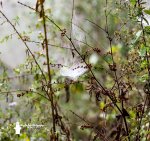
Forage Friday #42 Bandages

Hello friends! Tonight’s feature image was taken just for Forage Friday. All of the photos are my original work and are available for purchase by the instructions at the bottom of the article.

Disclaimer: Forage Friday is only intended to be a conversation starter and not a replacement for real training. I am not a doctor and therefore not qualified to give any medical advice. I also feel like it should be stated that for deep wounds it is possible to seal in an infection and cause the wound to become gangrenous so I urge you to seek out a professional for further information.

Being a native Mountaineer means growing up in culture that’s heavy with “folk medicine”. Not all of these home remedies work and there’s quite a few that are downright dangerous. One example would be story about a young couple who’s child was burned in an accident and it was appeantly a pretty bad burn. Panicked and at a time when reaching a medical professional was difficult under the best of circumstances they defaulted to a folk cure based on the old saying that “Fire draws fire” and that saying is true. But the problem is that this particular saying is referring to how to control a forest fire and not how to treat a burn. It goes without saying that the child did not survive. Now it might have been a true story or it might have been a cautionary tale about using common sense but it made an impression on me.

In spite of the warning I continued to be fascinated by the ways people in isolated locations were able to provide so many daily needs from the landscape. I learned that for every old wives tale there was several things that actually worked and would later be confirmed by science. Such is the case with “Spider’s stitches” or using a cobweb as a bandage. Unlike a lot of the old folk sayings there wasn’t any rhymes about bandaging wounds with webs. It was just the simple statement of “You can use spiderweb on a cut.” My young mind filed away the knowledge but I always questioned whether or not it was true. Spiders are all gross and “buggy”! How could anyone put a nasty old cobweb on a place where it will mix with blood? Wouldn’t it cause an infection?

Well, it turns out that spiders might look gross but they’re actually neat freaks that are constantly grooming themselves and their webs. They’re almost OCD about keeping themselves clean. And their webs contain substances that prevent bactira, viruses and fungi from growing. It also turns out that the web is rich in vitamin K and sticky enough to hold a wound closed. It’s like God knew that we would be clumsy and made the spider to help us out.

There are a few rules to follow though. Number one being avoid the spider itself of course. Black Widow bites are notoriously painful. They’re often described as a body wide Charlie horse that lasts for 48 hours and the internet is full of nightmarish images of what the brown recluse spider can do. Fortunately, the black widow spider is very non-aggressive and the recluse would rather hide than even be seen. Most spiders don’t even have a type of venom that affects humans.

Next, is all the images of beautifully woven orbs covered in fresh dew. Now I’m certain that those orbs would work but they’re a bit thin and you’d need a lot of them. However the thick ones on top of the grass are perfect.

Be sure to use new ones that clean and free from captured prey to avoid contamination. A dirty web means either the spider has been gone for a while or that there’s something wrong with the spider.

Place the web inside the would. I know that seem wrong the it’s the most effective way. You can top the dressings off with leaves like Plantago and Comfrey for extra strength and wrap it up with long grasses.

I hope that you have enjoyed this week’s Forage Friday post. 😊

Hello Friends and thank you for your support of my page. If you have enjoyed the photos or the writings please let me know by commenting and sharing my work on your social media. I also want to invite you to Follow Lloyds Lens Photography on Facebook

If you would like to Follow me on Facebook the web address is

https://www.facebook.com/aviewfromthelens/

If you’re enjoying my blog and don’t want to miss a post then you can sign up for email alerts on my website.

https://lloydslensphotographyllc.com/

Did you know that I also do portraits by appointment? If you’re interested in a portrait session either message me on Facebook or Use the Contact form. The YouTube link below takes you one of my slideshows.

https://youtu.be/FDcrY6w8oY8

Have you checked out the Zazzle Store?

I’m now using Zazzle to fulfil orders. What this means for you is a secure way to place an order, discount codes & a broader product selection! Simplymessage me on Facebookoruse the contact form on my websiteand tell me which image you want and I’ll reply with a direct link to where you can place the order.

Clicking on the photo takes you tohttps://www.zazzle.com/lloydslensphotos?rf=238248269630914251Lastly, all of the photos and writings are my original work unless otherwise specified and are not to be copied or reproduced without expressed written permission from the photographer.

Thank you again for your support of my page!❤

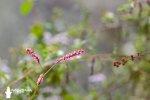
Forage Friday #41 Smartweed

Hello friends! Tonight’s feature image is titled “Smartweed On Panther Mountain” and is available for purchase by the instructions at the bottom of the article.

Smartweed is one of those plants that has negative effects on some people. It’s said that eating large quantities of Smartweed can cause a sensitivity to the sun and some people can get a rash from skin contact with the plant. However, I have enjoyed Pennsylvania Smartweed fresh off the plant without any negative impact.

One of the first forage plants that I decided to try many years ago was Smartweed. It’s a pretty common plant that’s found throughout North America and it’s in almost every state except Utah and Nevada. Polygonum is a large genus of plants in the Buckwheat family and the different types of Smartweed can vary in spiciness. Think of different types of peppers ranging from a very mild bell pepper to the dreaded Carolina Reaper and you’ll get the idea. So with that in mind I should be clear that I’m speaking of Lady’s Thumb and Pennsylvania Smartweed. Both plants have a characteristic dark spot on the leaves ( I’ll try to do a follow-up this spring when they’re nice and fresh and get a good shot of the leaves) but the spot on Lady’s Thumb is more like a smudge where Pennsylvania Smartweed’s spot tends to be a chevron. The plant I have the most of is the Pennsylvania Smartweed. The peppery flavor tends to be stronger in Pennsylvania Smartweed but my experience with it is that the leaf is relatively mild when compared to other spices. If you’ve never tried Smartweed before then I do recommend starting with a very small piece ( about the size of the tip of your pinky finger) until you’re sure that the plant agrees with your palette. The stronger tasting Pennsylvania Smartweed leaves are mostly used as a spice.

Lady’s Thumb leaves are so mild that they can be used as a substitute for spinach in salads. Or, even cooked and served as a pot herb. The pink flowers of both plants are used as an edible garnishment.

At some point those pretty pink flowers turn white. When they do the seeds are ripe and can be collected in a paper bag and dried to be ground as a substitute for black pepper. From what I’ve read that’s the traditional European use for Smartweed. Again, remember that some varieties are more potent than others and the seeds of both Lady’s Thumb and Pennsylvania Smartweed are more spicy than the leaves. To use the seed they’ll need to be freed from the papery husk and rubbing them in your hands works just fine. Allow the seeds and husks to fall on a plate and then gently blow the paper away. Carefully tossing them up while blowing will also help.

The plant is Native to Europe but was brought here by the colonists and quickly became a Native American favorite. It was used medically to treat a variety of issues including arthritis and poison oak rash. ( Again, some people get rash from it so I would test myself before treating poison oak with Smartweed. )

As I mentioned above my plan is do a follow-up this spring when I can get some more images that includes the leaves. Tonight’s feature image was actually a calibration shot from an earlier project and since foraging can be a little bit of a challenge this time of year I decided to use it.

Before I close I’m going to toss out a reminder that if you forage please remember to either forage your own land or gain permission from the landowner and always respect private property.

Hello Friends and thank you for your support of my page. If you have enjoyed the photos or the writings please let me know by commenting and sharing my work on your social media. I also want to invite you to Follow Lloyds Lens Photography on Facebook

If you would like to Follow me on Facebook the web address is

https://www.facebook.com/aviewfromthelens/

If you’re enjoying my blog and don’t want to miss a post then you can sign up for email alerts on my website.

https://lloydslensphotographyllc.com/

Did you know that I also do portraits by appointment? If you’re interested in a portrait session either message me on Facebook or Use the Contact form. The YouTube link below takes you one of my slideshows.

https://youtu.be/FDcrY6w8oY8

Have you checked out the Zazzle Store?

I’m now using Zazzle to fulfil orders. What this means for you is a secure way to place an order, discount codes & a broader product selection! Simplymessage me on Facebookoruse the contact form on my websiteand tell me which image you want and I’ll reply with a direct link to where you can place the order.

Clicking on the photo takes you tohttps://www.zazzle.com/lloydslensphotos?rf=238248269630914251Lastly, all of the photos and writings are my original work unless otherwise specified and are not to be copied or reproduced without expressed written permission from the photographer.

Thank you again for your support of my page!❤
Forage Friday #39 Virginia Creeper ( by special request)

Hello friends! Tonight’s feature image is titled “The Creeper On The Stairs” and is available for purchase by the instructions at the bottom of the article.

Before we dig into tonight’s Forage Friday post I have to address an issue that was raised by a comment on one of the Facebook groups I share with. The commenter said that she had trouble with trespassers “foraging” on her property. And that she had to involve the police because of the damage done to the plants she had reserved for her own use. So, in no way, shape or form should anyone enter private property without permission from the landowner.

Today I received an email from Annette who wanted to ask about Virginia Creeper. Specifically, if it could be used to make rope. The answer is yes. But, there are better options. Virginia Creeper is a strong flexible vine native to the Appalachian Mountains. It’s often mistaken for poison ivy but Virginia Creeper has five leaves per cluster where poison ivy only has three leaves per cluster. Both vines can have what’s called prop roots that hold them to the sides of structures and trees so without the leaves it can be hard to tell the difference. Especially with young vines that are the size one might use to lash poles together for a shelter. One of the identification factors for Virginia Creeper is that it’s tendrils branch out and end in little disks.

I have never had an allergic reaction to Virginia Creeper but in research for this article I learned that some people do get a rash but it’s mild.

As cordage the use of Virginia Creeper seems to be in baskets. The supple vine is woven between limber twigs and is strong enough to hold a moderate amount of weight.

A better option for cordage might be spruce roots which are both stronger and more flexible but in a lot West Virginia spruce is not as available as Virginia Creeper. Another good option would be young grape vines.

Virginia Creeper is not a type of grape but is a “cousin” of grape. However Virginia Creeper berries are listed as toxic with a list of nasty symptoms of poisoning.

In spite of the warnings of a possible rash Peterson’s Field Guide says that Native Americans used the leaves of Virginia Creeper to treat the rash of poison sumac and that the leaves are used in combination with vinegar to wash wounds. But, this is something that I do not have firsthand knowledge of and therefore I can’t really say if it works.

The most common use for Virginia Creeper is in landscaping. The vine can be planted as a way to provide shade and turns a beautiful velvety red in Fall.

Hello Friends and thank you for your support of my page. If you have enjoyed the photos or the writings please let me know by commenting and sharing my work on your social media. I also want to invite you to Follow Lloyds Lens Photography on Facebook

If you would like to Follow me on Facebook the web address is

https://www.facebook.com/aviewfromthelens/

If you’re enjoying my blog and don’t want to miss a post then you can sign up for email alerts on my website.

https://lloydslensphotographyllc.com/

Did you know that I also do portraits by appointment? If you’re interested in a portrait session either message me on Facebook or Use the Contact form. The YouTube link below takes you one of my slideshows.

Have you checked out the Zazzle Store?

I’m now using Zazzle to fulfil orders. What this means for you is a secure way to place an order, discount codes & a broader product selection! Simplymessage me on Facebookoruse the contact form on my websiteand tell me which image you want and I’ll reply with a direct link to where you can place the order.

Clicking on the photo takes you tohttps://www.zazzle.com/lloydslensphotos?rf=238248269630914251Lastly, all of the photos and writings are my original work unless otherwise specified and are not to be copied or reproduced without expressed written permission from the photographer.

Thank you again for your support of my page!❤

Forage Friday #38 Mistletoe

Hello friends! Tonight’s feature image was taken just for Forage Friday. All of the photos are my original work and are available for purchase by the instructions at the bottom of the article.

While mistletoe is not known to have ever caused human death it is toxic and is likely to make you very sick. I normally wouldn’t include such a plant in a Forage Friday post however it does have a market value as a Christmas decoration could feed you indirectly if you’re crafty enough to collect it and transform it into decor to be sold as such for a profit.

Throughout the Appalachian Mountains the bare branches stand out in contrast to the sky. However, along the Kanawha River some of the trees still have thick green clusters of leaves that seem to form lose spherical shapes in random locations in the trees. In winter this is the tell tale sign of mistletoe.

As stated in the warning above mistletoe has no food value. It is a parasite to the tree that hosts it and often causes deformation of wood. It’s peg like root grows into the cambium layer and diverts nutrients from the branches. The white sticky seeds are toxic except to birds. In fact, the only thing that mistletoe has going for it the culture that’s provided a niche for it to fill.

I have done a little research on the origin of mistletoe as a Christmas tradition and following is a very abbreviated layman’s version of the tradition of kisses under the mistletoe.

Well before that famous kiss between mommy and Santa Claus the mistletoe plant was a symbol of love and benevolence in the Norse cultures. I know that Thor gets all the Press because of Marvel’s Avengers and Stan Lee’s wonderful imagination but back the Baldr ( Sometimes spelled Balder) was the big hero. In the Norse mythology Baldr was a god with a pretty impressive talent. He was invulnerable. So much so that the other gods made a game of testing their weapons on him. However, Loki managed to learn that Baldr’s one weakness was mistletoe and depending on the version of the story struck him with either a dart or an arrow made from mistletoe. Which of course lead to Loki being asked to leave the party in an unceremonious manner. Everyone was bummed out over the death of Baldr including the mistletoe. So the Norse gods struck a deal with mistletoe. ( everything in Norse mythology has a personality) Mistletoe would promise never allow itself to be used as a weapon again ( in spite of the fact that it is a poison) and in return the gods would make it a symbol of love.

Then in 18th century England (and presumably because the myth had gained some resurgence ) a “game” was created where merrymakers were allowed to steal a kiss from any girl caught under the mistletoe. There also seemed to be a rule that for each kiss a white berry was removed from the sprig and once the berries were all gone the kissing game was over.

I have tried to learn how the mistletoe tradition made it into the Christian traditions of Christmas. As the church began to adapt it’s own versions of the pagan holidays many the elements were converted and assigned an alternative myth. However, mistletoe seems to have been more tolerated than adapted and therefore I could no alternate myth.

I did mention that if you’re crafty enough to make a kissing ball that mistletoe might provide a little extra holiday income. I couldn’t find any special instructions for preserving mistletoe however Southern Living magazine recommends harvesting the sprigs with a shotgun. Now I like to shoot guns but I’m going to recommend that you use a pole pruner so as not to have little holes in your decorations. 😉

I did a quick check on Amazon for a mistletoe kissing ball and an 8 inch diameter plastic kissing ball was priced at $12-$15. My gut feeling is that a well made natural mistletoe ornament should be worth at least $25 and there’s plenty of craft shows and farmer’s markets to sell them in.

Hello Friends and thank you for your support of my page. If you have enjoyed the photos or the writings please let me know by commenting and sharing my work on your social media. I also want to invite you to Follow Lloyds Lens Photography on Facebook

If you would like to Follow me on Facebook the web address is

https://www.facebook.com/aviewfromthelens/

If you’re enjoying my blog and don’t want to miss a post then you can sign up for email alerts on my website.

https://lloydslensphotographyllc.com/

Did you know that I also do portraits by appointment? If you’re interested in a portrait session either message me on Facebook or Use the Contact form. The YouTube link below takes you one of my slideshows.

https://youtu.be/FDcrY6w8oY8

Have you checked out the Zazzle Store?

I’m now using Zazzle to fulfil orders. What this means for you is a secure way to place an order, discount codes & a broader product selection! Simplymessage me on Facebookoruse the contact form on my websiteand tell me which image you want and I’ll reply with a direct link to where you can place the order.

Clicking on the photo takes you tohttps://www.zazzle.com/lloydslensphotos?rf=238248269630914251Lastly, all of the photos and writings are my original work unless otherwise specified and are not to be copied or reproduced without expressed written permission from the photographer.

Thank you again for your support of my page!❤

Forage Friday #37 Witch Hazel

Hello friends! Tonight’s feature image is titled “Witch Hazel 121319A”. All of the photos are my original work and are available for purchase by the instructions at the bottom of the article.

The young boy was fighting back his tears as he sat on the edge of the tub while his mother washed the dirt and blood from his knees. The cool water from the tap helped to numb his wounds a little. The abrasions were not that bad once they were cleaned up but when you’re that young everything seems like an emergency. His mother spoke in a soothing voice and braced her child for the next step. She retrieved an amber bottle from the medicine cabinet and poured out a clear liquid into a cotton ball. The medicine stung his broken skin at first but soon the astringent qualities of the witch hazel kicked in and made the pain stop.

It’s rare that I do a Forage Friday post on a plant that to the best of my knowledge has absolutely no uses as food. But witch hazel is one of those plants that is probably already in your own medicine cabinet. The parts used are the leaves, twigs and inner bark. However, it’s because of it’s late Fall/Early Winter bloom that I’ve waited until now to include it in a Forage Friday post.

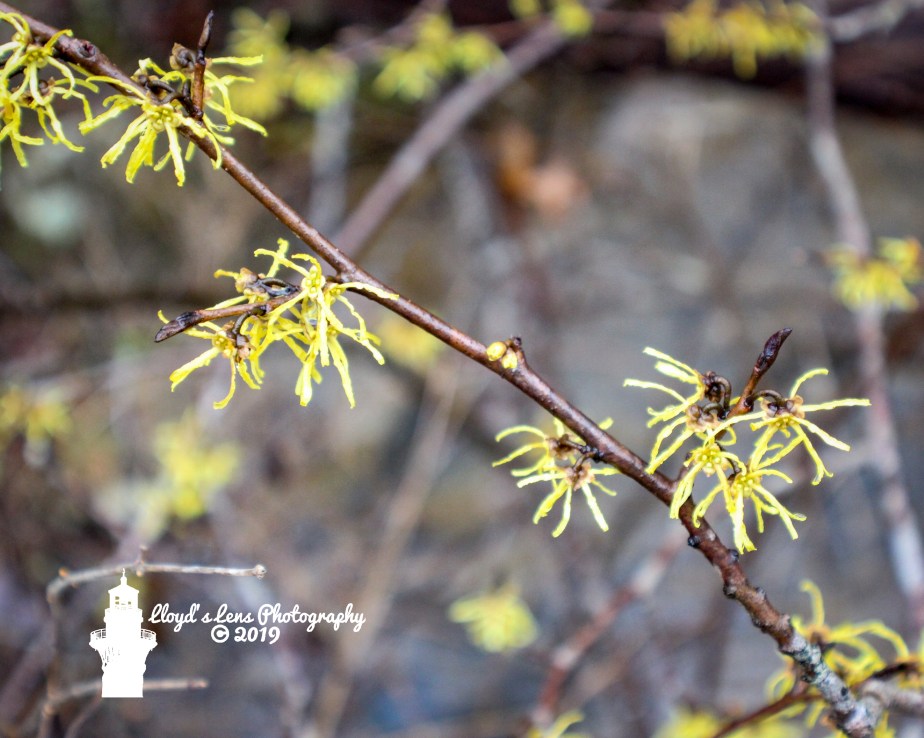
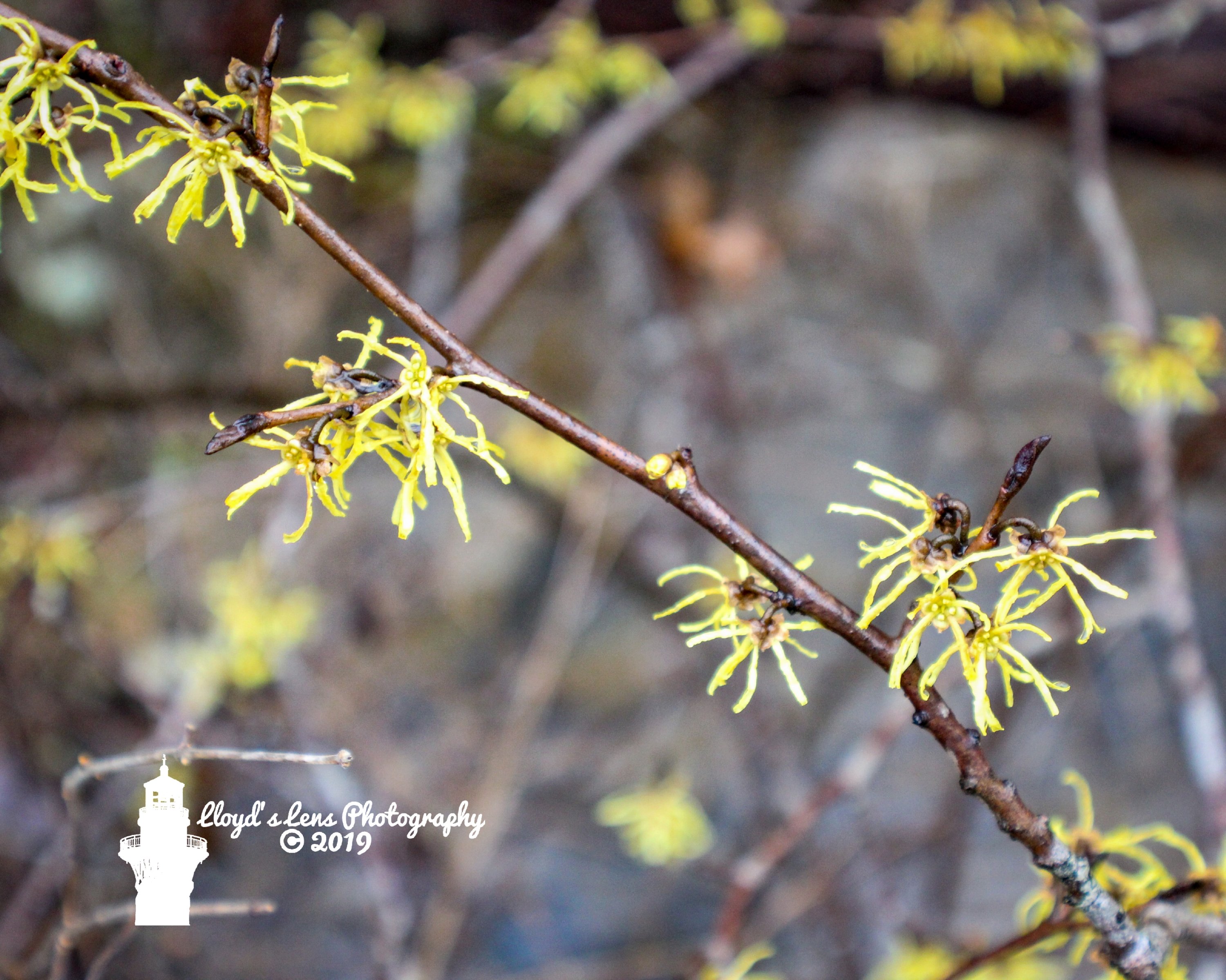
Witch Hazel flowers are a beautiful sight during the dark rainy days of December. 

The delicate flowers of witch hazel always seem to open at just the right time to add some beauty to the otherwise disheartening landscape.  They’re also pollinated by winter moths that are able to survive freezing temperatures by living in the leaf litter to hide from the cold. Wild witch hazel is what we see in tonight’s pictures but a quick Google search shows that there are cultivars that can be planted and have a bloom that is more showy and displays various shades of red and orange.

I also learned while researching the article that there is only one industrial provider of witch hazel in the United States. The trees are farmed on a river bank. Once they’re ready for harvest the entire tree is coppiced (cut so that it will regenerate and friends back) and chipped. The chips are then dumped into vats of alcohol where the tannins are leeched out and then the alcohol is cooked off. The description of the process implies that the steam is collected and condensed into the liquid we find under various labels. It all comes from one supplier and there seems to be a lot of regulatory requirements that guide the production.

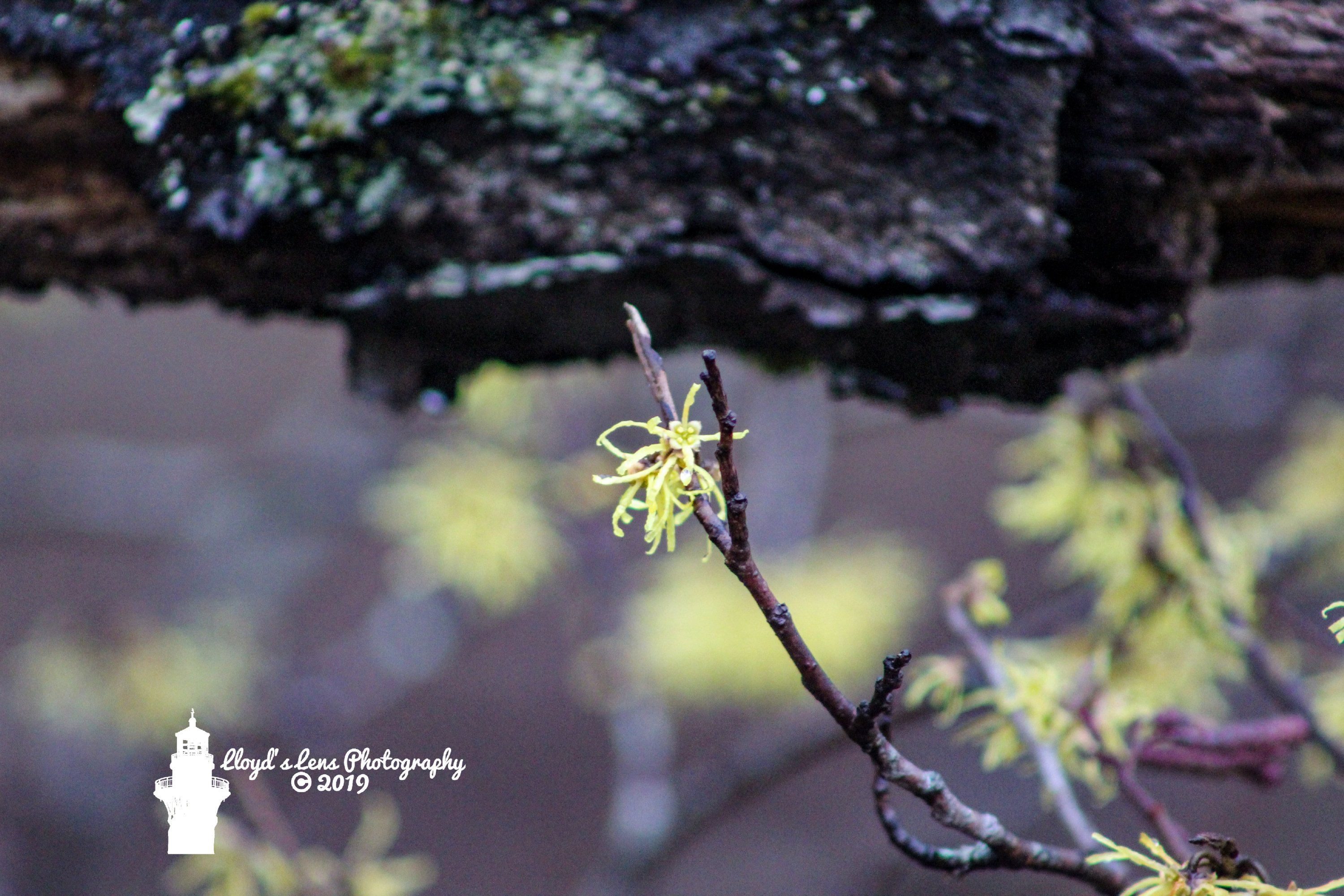
A witch hazel twig showing the bud and leaf scar. Leaf scars are like fingerprints that help identify the tree. Witch hazel buds resemble a deer’s hoof.

I also found a process for home production.  It was rather simple.  Collect the leaves, twigs and inner bark (one tablespoon per cup of distilled water) and soak them in water for about 30 minutes and then bring it to a boil. Simmer for ten minutes. Allow the decoction to steep for another ten minutes before straining and bottling.

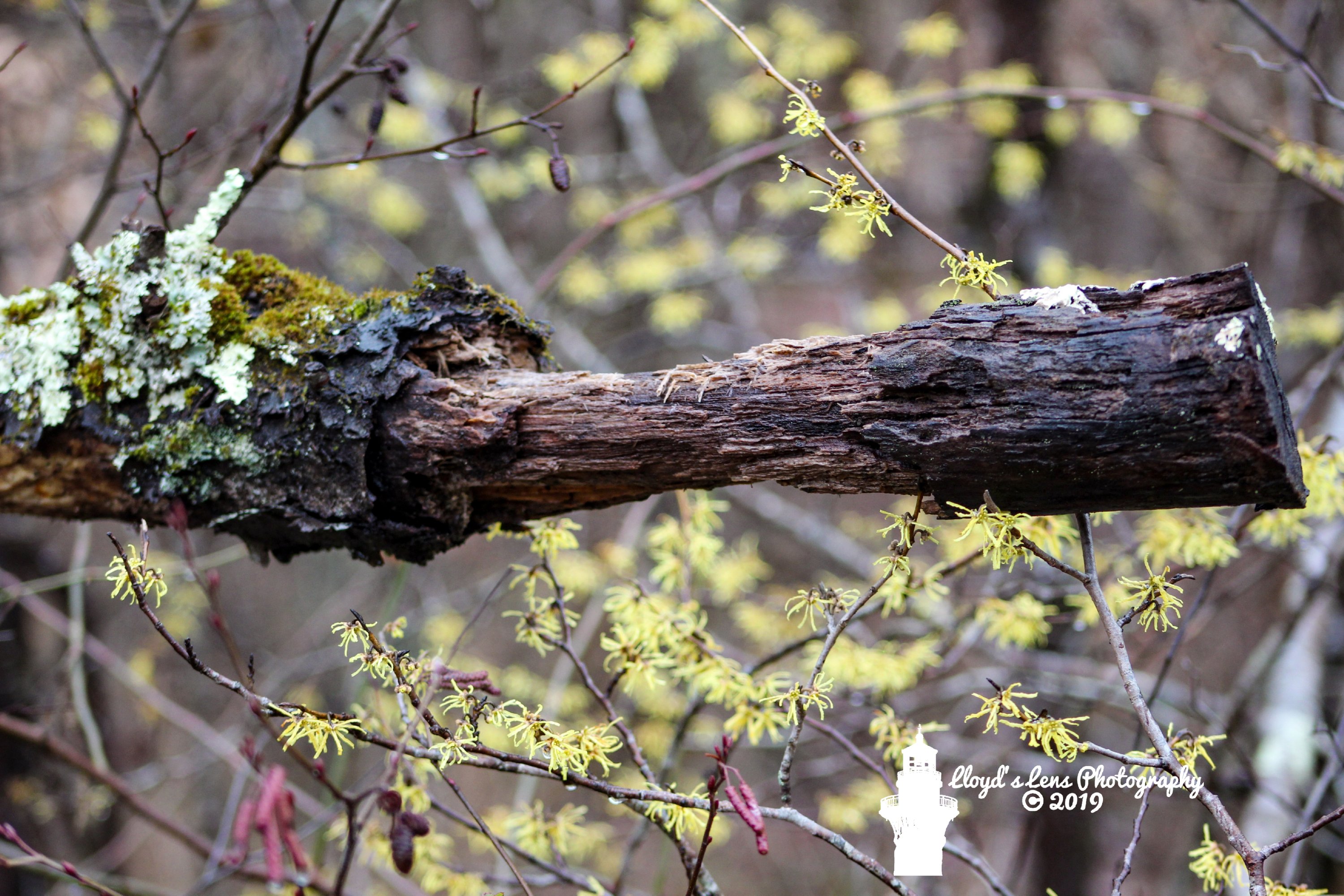
The beautiful witch hazel growing with the alder from last night’s article.

I’m constantly scanning the environment for native species to incorporate into my landscape. While I’m probably never going to produce enough witch hazel to unseat the one supplier it is not only a beautiful flowering bush to help add color in the winter but a handy resource to have around a homestead.

Hello Friends and thank you for your support of my page. If you have enjoyed the photos or the writings please let me know by commenting and sharing my work on your social media. I also want to invite you to Follow Lloyds Lens Photography on Facebook

If you would like to Follow me on Facebook the web address is

https://www.facebook.com/aviewfromthelens/

If you’re enjoying my blog and don’t want to miss a post then you can sign up for email alerts on my website.

https://lloydslensphotographyllc.com/

Did you know that I also do portraits by appointment? If you’re interested in a portrait session either message me on Facebook or Use the Contact form. The YouTube link below takes you one of my slideshows.

https://youtu.be/FDcrY6w8oY8

Have you checked out the Zazzle Store?

I’m now using Zazzle to fulfil orders. What this means for you is a secure way to place an order, discount codes & a broader product selection! Simplymessage me on Facebookoruse the contact form on my websiteand tell me which image you want and I’ll reply with a direct link to where you can place the order.

Clicking on the photo takes you tohttps://www.zazzle.com/lloydslensphotos?rf=238248269630914251Lastly, all of the photos and writings are my original work unless otherwise specified and are not to be copied or reproduced without expressed written permission from the photographer.

Thank you again for your support of my page!❤