Hello Friends! Tonight’s Feature Image is titled “Plains Coreopsis 100620a” and is available for purchase by clicking the thumbnail and reaching out to me on the contact page.
The gentle October winds gently shake the field near the Battle Run Campground at Summersville Lake. Small grasshoppers spring into the air and take wing through the drying stems of fading wildflowers. Occasionally a Sulphur Butterfly flutters through checking each bloom for the disappearing nectar. They’ll need every precious drop of energy to make the long journey south. Along with the butterflies Fenches,Chickadees and Wrens forage the tall weeds of the spillway. Some search for insects and others pick seeds from stems that held the wildflowers a few short days ago. The small ones are silent as they feed but in the distance the caw of crows carry on the breeze reminding us that they own the lake now. Gone are the skiers and swimmers and the lower waterline now draws more attention from fishermen trolling the banks in hopes of raising a monster from the inky depths. The soft down of thistle floats gently by and turns skyward. In my inner child’s imagination I see it fly to heaven above and land on a cloud at the feet of an angel who will guard it well until the Spring planting. The seasons flow like a river and nobody can hold it all in their hands. Here in the waning water days of the sun I learned to enjoy the last light rather than mourn its loss. Light to us humans is like the last drops of nectar for the butterflies. We should take in as much as we can to carry us through our journey.
And with this thought I close tonight’s post. Enjoy your time and be blessed throughout your days.
Hey Friends! Just a quick reminder that Lloyds Lens Photography is available for portraits!
Tobook me simply reach out using theContact Pageand we’ll set a date. If you’re within a 50 mile radius of Summersville West Virginia all travel fees are waived.
If you would like to Follow me on Facebook the web address is
I’m now using Zazzle to fulfil orders. What this means for you is a secure way to place an order, discount codes & a broader product selection! Simplymessage me on Facebookoruse the contact form on my websiteand tell me which image you want and I’ll reply with a direct link to where you can place the order.
Lastly, all of the photos and writings are my original work unless otherwise specified and are not to be copied or reproduced without expressed written permission from the photographer
Hello Friends! Tonight’s Feature Image is titled “Blue Winged Wasp 90820a” and is available for purchase by clicking the thumbnail and reaching out to me on the contact page.
Our Friend Cindy asked me for help identifying a wasp that she spotted. What she described is a Blue Winged Wasp.
The late summer sun casts its glow across the open field illuminating the insects that buzz about a few inches above the grass. They seem to ignore me as I wade through them although several nearly collide with my bare legs. They’re definitely wasps and at first glance they look like yellow jackets swarming but they made no aggressive movements so I persisted until I spotted one at eye level. This wasp feeds on pollen and nectar which means it’s not a yellow jacket or hornet of any kind. It’s docile behavior gave me confidence to move in for a closer look however I cautious about crowding it. The body is black and the wings are iridescent blue like a mud dauber but it’s abdomen is orange with two large yellow spots. This is a “Digger Wasp” which is also known as a Blue Winged Wasp or sometimes Blue Winged Digger. The scientific name is Scotia dubia. This gentle wasp is actually a friend of gardeners.
It gets the name Digger Wasp because when it’s not feeding on pollen and nectar it’s hunting grubs in the lawn or garden. It specifically targets scarab beetles like June bugs and Japanese Beetles. Somehow it’s able to detect them underground well enough to distinguish scarab beete grubs from the hundreds of other grubs the feed on the tender roots of our lawns and vegetables. The online community was was sparse on the finer points of how this is accomplished but I suspect that those heavy club like antenna are the secret. Insects use their antenna to smell with. If you look closely at moths and butterflies you’ll notice that their antenna are either feathered or club shaped. In most butterflies the antenna end in bulbs. These bulbs are clusters of olfactory nerves that can sense oders over great distance. In the Blue Winged Wasp we see that the antenna are thick the entire length. I wasn’t really able to confirm it but it stands to reason that the antenna are thick because they contain a lot of these nerve clusters. I suspect that they know where the beetle larvae is by smelling them below ground. Once they have their target they will tunnel right down to the grubs and paralyze them with a sting. Sometimes they they lay a single egg right there where they captured the grub but other times they’ll bury it to hide it while they dig a better hole to place it in and then lay the egg after the grub has been moved. The grubs are not dead. They’re only paralyzed and when the egg hatches the wasp larvae eats the grub. A Blue Winged Wasp larvae will then spin an underground cocoon and transform into an adult Blue Winged Wasp.
The Blue Winged Digger Wasp is a solitary wasp. They are found in clusters but only if there’s sufficient scarab beetles to host the eggs. In 2016 a wet Spring led to an increase of Scarab Beetles and then a wave of these predators which is still going strong today in some areas.
There is an interesting tidbit about this wasp’s relationship with certain orchids. Some orchids have adapted to mimic the female in this family of wasps. The male becomes confused and mates with the orchids and by doing so pollenates the orchids.
White any wasp will become aggressive if you step on them or try to catch them the Blue Winged Digger Wasp is not generally considered a problem. When they are not controlling the scarab beetles they are likely pollinating orchids as mentioned before or the females are visiting one of the other wildflowers such as Goldenrod or wingstem.
Image Titled “Blue Winged Wasp 90820b” and is available for purchase by clicking the thumbnail and reaching out to me on the contact page.
Overall, every state extension office between the Eastern Shoreline and the Rocky Mountains listed the Blue Winged Digger Wasp as a beneficial insect so if you have them around they’re only there to help.
That’s it for tonight friends and be blessed throughout your days.
Hey Friends! Just a quick reminder that Lloyds Lens Photography is available for portraits!
Tobook me simply reach out using theContact Pageand we’ll set a date. If you’re within a 50 mile radius of Summersville West Virginia all travel fees are waived.
If you would like to Follow me on Facebook the web address is
I’m now using Zazzle to fulfil orders. What this means for you is a secure way to place an order, discount codes & a broader product selection! Simplymessage me on Facebookoruse the contact form on my websiteand tell me which image you want and I’ll reply with a direct link to where you can place the order.
Lastly, all of the photos and writings are my original work unless otherwise specified and are not to be copied or reproduced without expressed written permission from the photographer
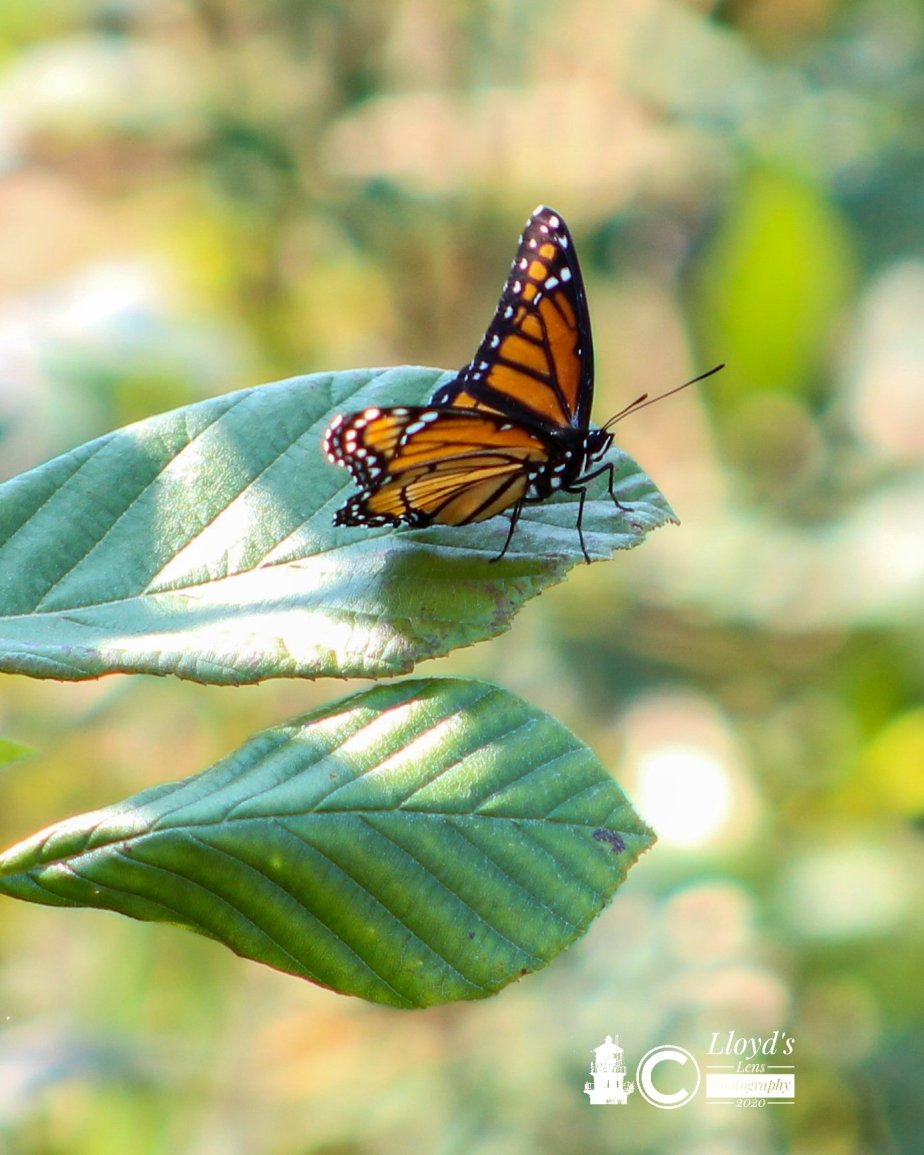
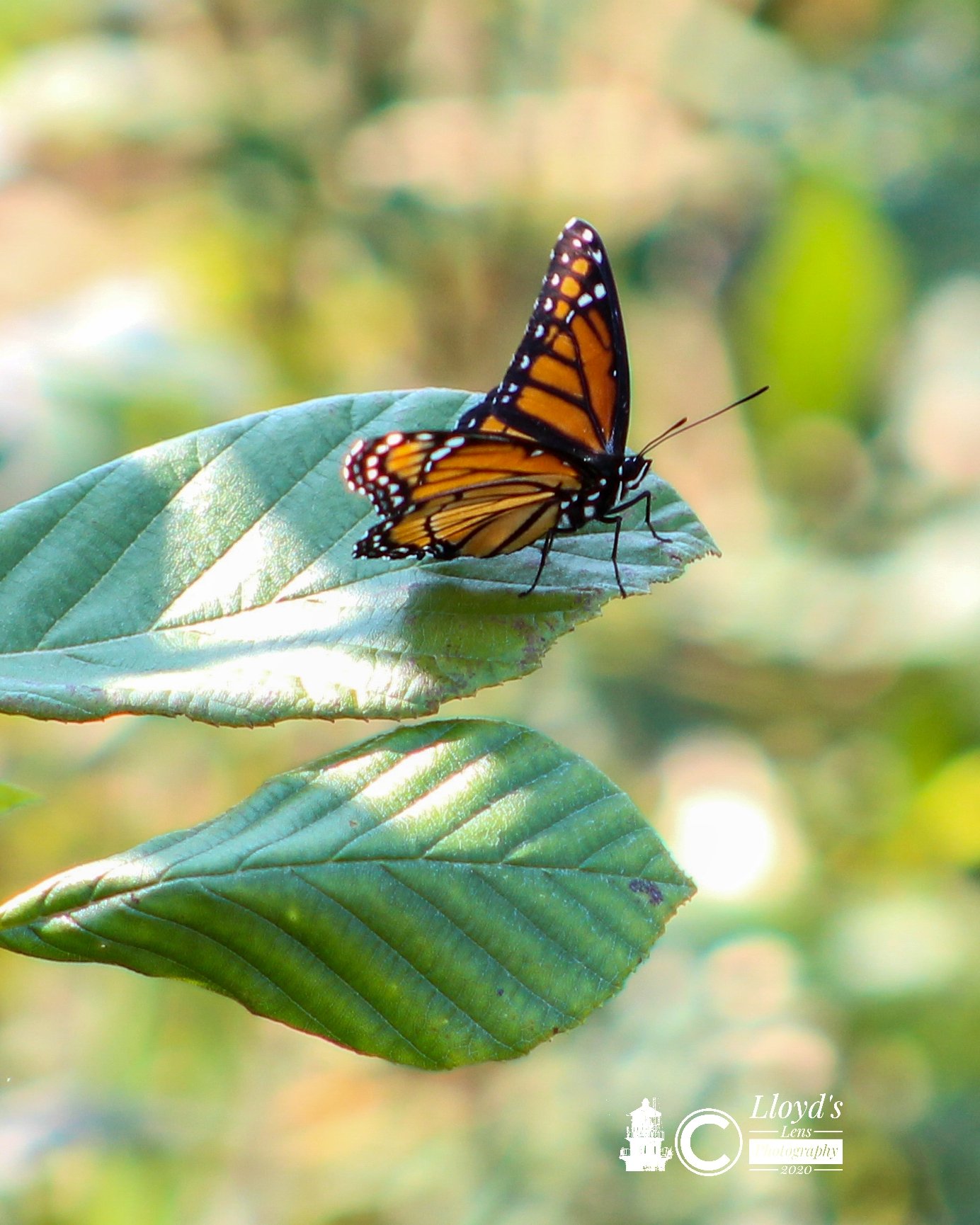
Hello Friends! Tonight’s Feature Image is titled “Viceroy Butterfly 91320” and is available for purchase by clicking the thumbnail and reaching out to me on the contact page. The warm September sun washes over the marshlands on Muddlety Creek as I creep along the edges watching for various wildlife to present themselves before my lens. In excitement I spotted the bright orange wings of a monarch butterfly resting on the leaves of an alder tree. But I was fooled. This was not a monarch. It’s in the “Royal Admiralty” along with the monarch but it’s a pretender to the butterfly throne. It is a Viceroy Butterfly. In fact, every butterfly that I have published as a monarch this year have actually been Viceroy Butterflies. The two butterflies along with the Queen Butterfly are closely related and all 3 have similar colors and markings but the heavy dark bar on the forewing of the Viceroy is the quickest way to distinguish it from the Monarch. The marshlands here are full of willows and that may account for the heavy concentration of Viceroy Butterflies in the area. Where the monarch hosts it’s eggs and caterpillars on milkweed the Viceroy hosts on willows. The Viceroy Butterfly concentrates the Salicylic Acid ( AKA aspirin) found in willows and poplars ( they also host on poplars) and this makes them poison to predators. Another thing that the Viceroy does to protect it’s babies is that the caterpillar looks like bird droppings. Which would certainly take them off the menu for birds.
That’s it for tonight friends. Be safe and be blessed throughout your days!
Hey Friends! Just a quick reminder that Lloyds Lens Photography is available for portraits!
Tobook me simply reach out using theContact Pageand we’ll set a date. If you’re within a 50 mile radius of Summersville West Virginia all travel fees are waived.
If you would like to Follow me on Facebook the web address is
I’m now using Zazzle to fulfil orders. What this means for you is a secure way to place an order, discount codes & a broader product selection! Simplymessage me on Facebookoruse the contact form on my websiteand tell me which image you want and I’ll reply with a direct link to where you can place the order.
Lastly, all of the photos and writings are my original work unless otherwise specified and are not to be copied or reproduced without expressed written permission from the photographer
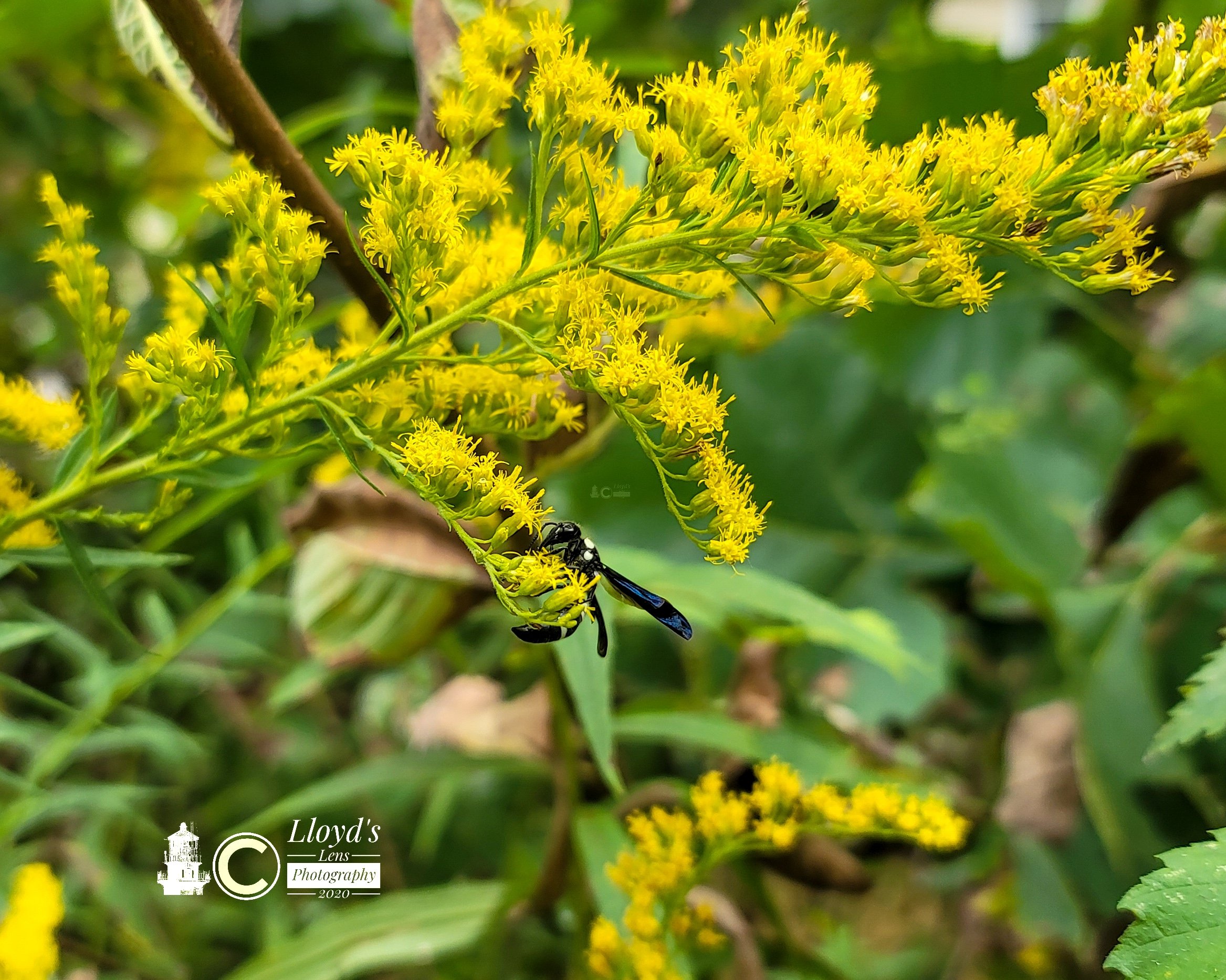
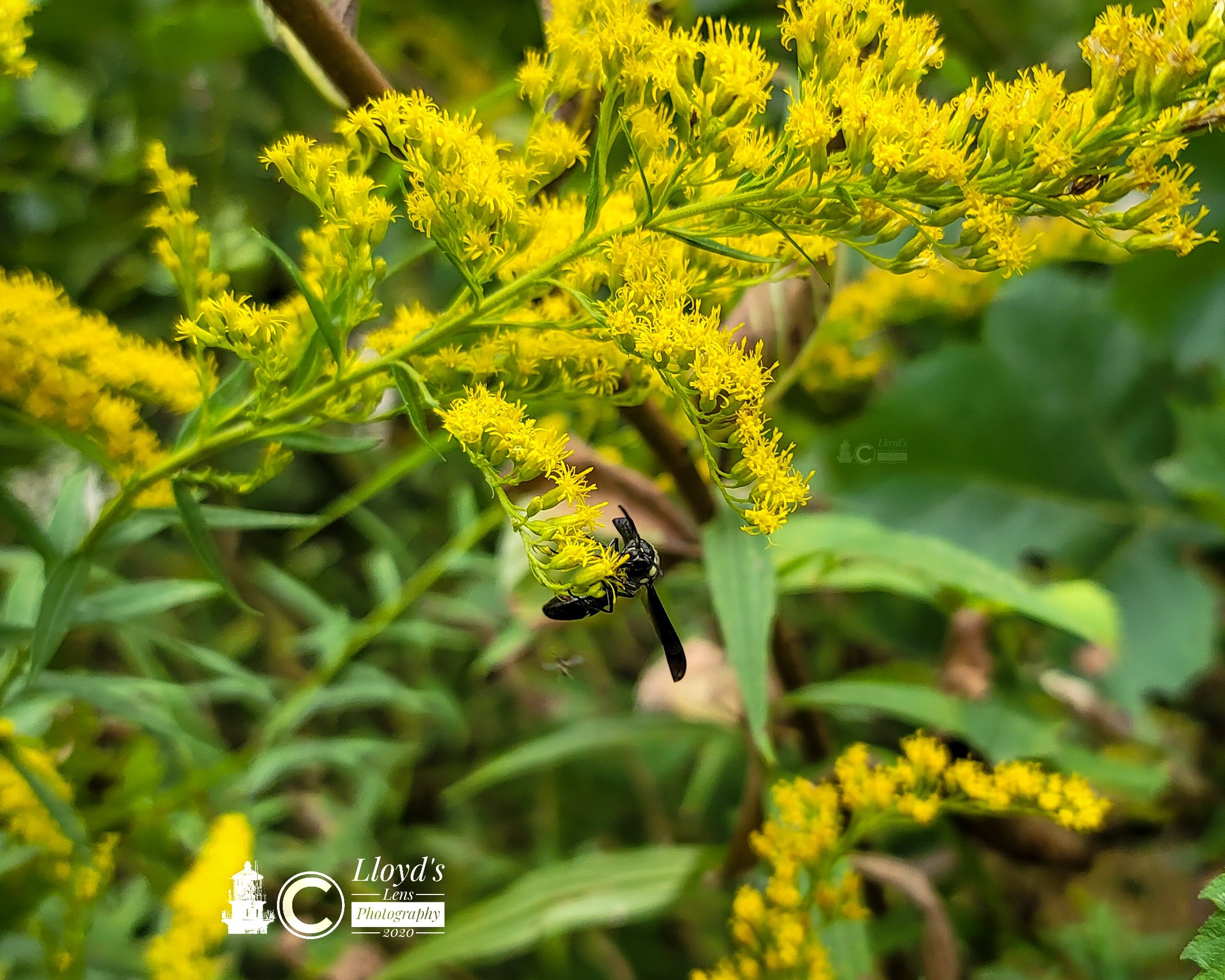
Hello Friends! Tonight’s Feature Image is titled “Potter Wasp And Goldenrod 92620a” and is available for purchase by clicking the thumbnail and reaching out to me on the contact page.
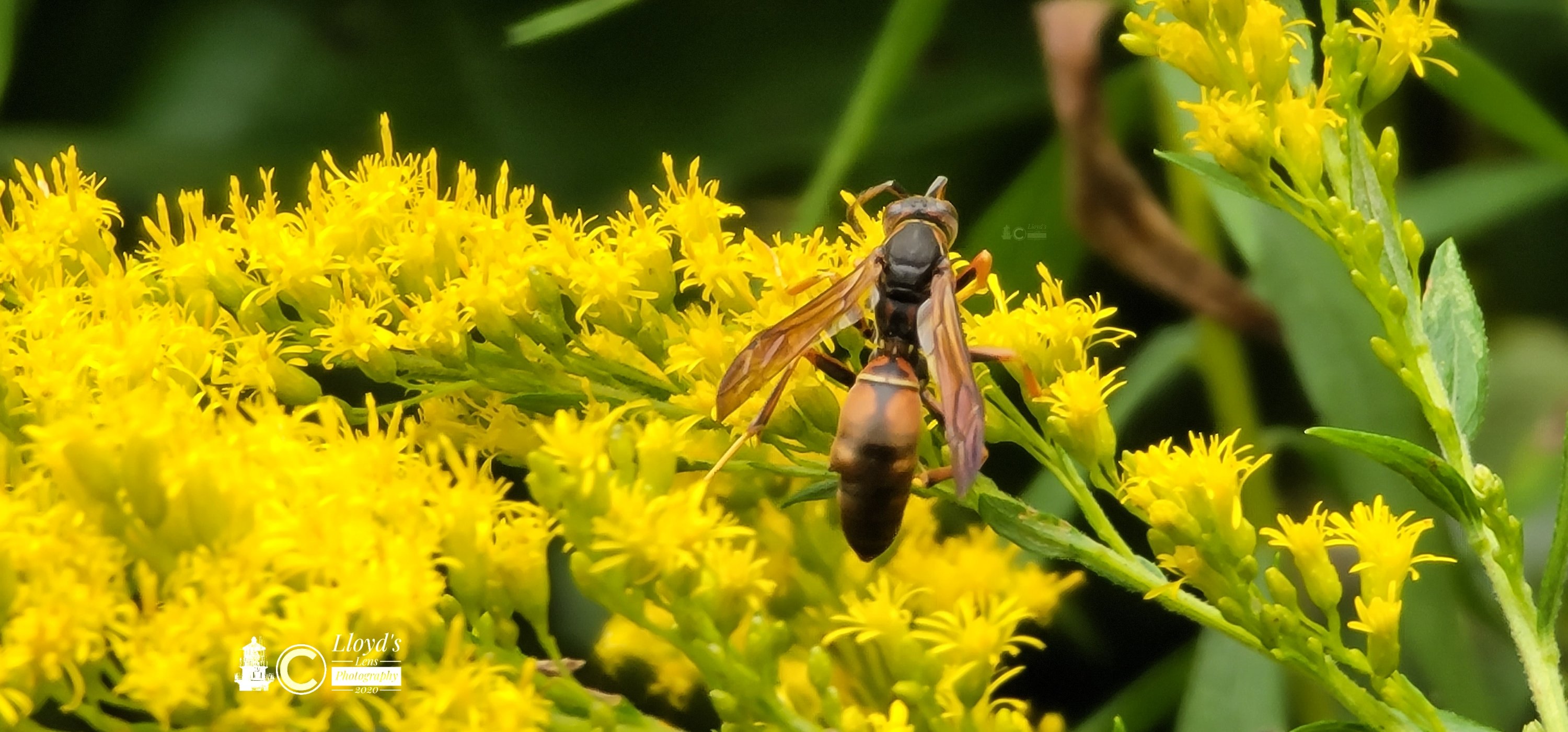
My big blue truck pulls into my driveway and I step out to check the mailbox. As I tuned to walk back to the truck I noticed the tell tale signs of wildflowers bobbing up and down when the wind is still. I have allowed nature to have it’s way on the banks of the creek in front of my as a form of erosion control and was blessed with a stand of Goldenrod. Goldenrod is a valuable late season resource for pollinators so it makes me happy to see the bright yellow spray of flowers in the fall. Especially when the bees are working on them. I put the mail in the truck and stepped around with my camera to see what kinds of bees and how many were enjoying the pollen and nectar that the flowers provide. There were a few honeybees but mostly I found native bumblebees and wasps. Typically I have a huge number of Paper Wasps. The brown kind that builds umbrella shaped nests on the eaves of my house. But one of wasps was different. It had blue iridescent wings and a black body with white spots. At first I thought it was a European Paper Wasp but when I did the research it turned out to be a Potter Wasp. This was is a native of the Eastern woodlands but it’s not one that I have seen often or if I did I just assumed it was something else. But now that I’m doing a lot of writing about the Appalachian Wildlife I’m more motivated to get the deeper details.
The Potter Wasp like many of the native bees and wasps seems to be solitary and like the name implies buids it’s nest from mud instead of paper. I’m used to seeing the long tunnel like nests of the Pipe Oregon Mud Dauber which are found on the houses and rocky out croppings of my mountain. But the Potter Wasp nest is much different. It’s actually vase shaped with a wide base and a narrow neck that flares out at the opening. The Potter Wasp will then paralyze a caterpillar and place it in the pot with a single egg. But while she feeds her young meat she herself feeds exclusively on pollen and nectar. And something about Goldenrod seems to really attract wasps in general. It’s not uncommon for me to find as many wasps feeding on the Goldenrod as I do true bees.
A paper wasp feeds on the Goldenrod next to the Potter Wasp
I am hoping to spot and photograph the unique nests of the Potter Wasp soon. I suspect that they are tucked away safely on some of rocks that surround my property and I’ll do a follow-up post when I see them but for now I just know that they’re in the area somewhere enjoying the late season bloom and pollinating my wildflowers.
Image Titled “Potter Wasp And Goldenrod 92620b” and is available for purchase by clicking the thumbnail and reaching out to me on the contact page.
Hey Friends! Just a quick reminder that Lloyds Lens Photography is available for portraits!
Tobook me simply reach out using theContact Pageand we’ll set a date. If you’re within a 50 mile radius of Summersville West Virginia all travel fees are waived.
If you would like to Follow me on Facebook the web address is
I’m now using Zazzle to fulfil orders. What this means for you is a secure way to place an order, discount codes & a broader product selection! Simplymessage me on Facebookoruse the contact form on my websiteand tell me which image you want and I’ll reply with a direct link to where you can place the order.
Lastly, all of the photos and writings are my original work unless otherwise specified and are not to be copied or reproduced without expressed written permission from the photographer
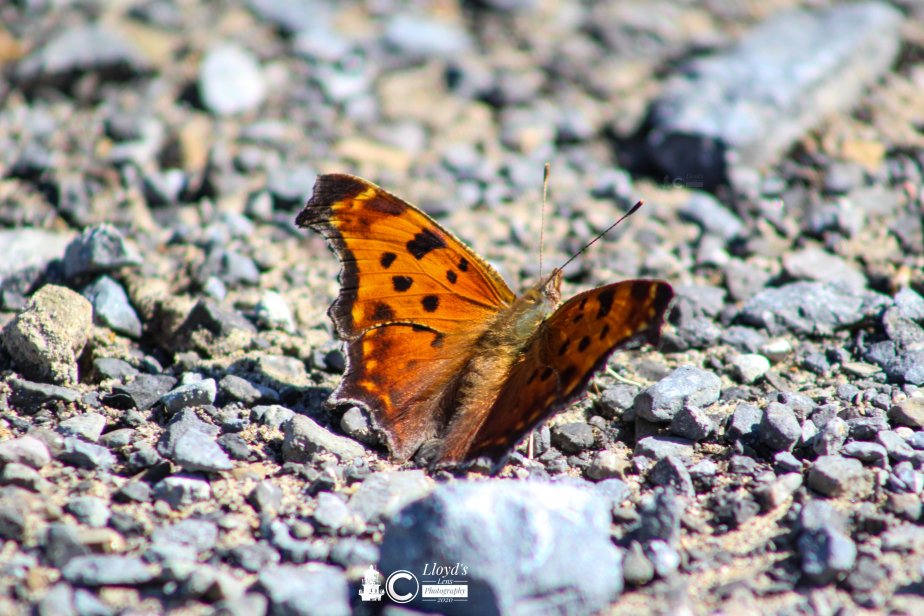
Hello Friends! Tonight’s Feature Image is titled “Comma Butterfly 100620a” and is available for purchase by clicking the thumbnail and reaching out to me on the contact page.
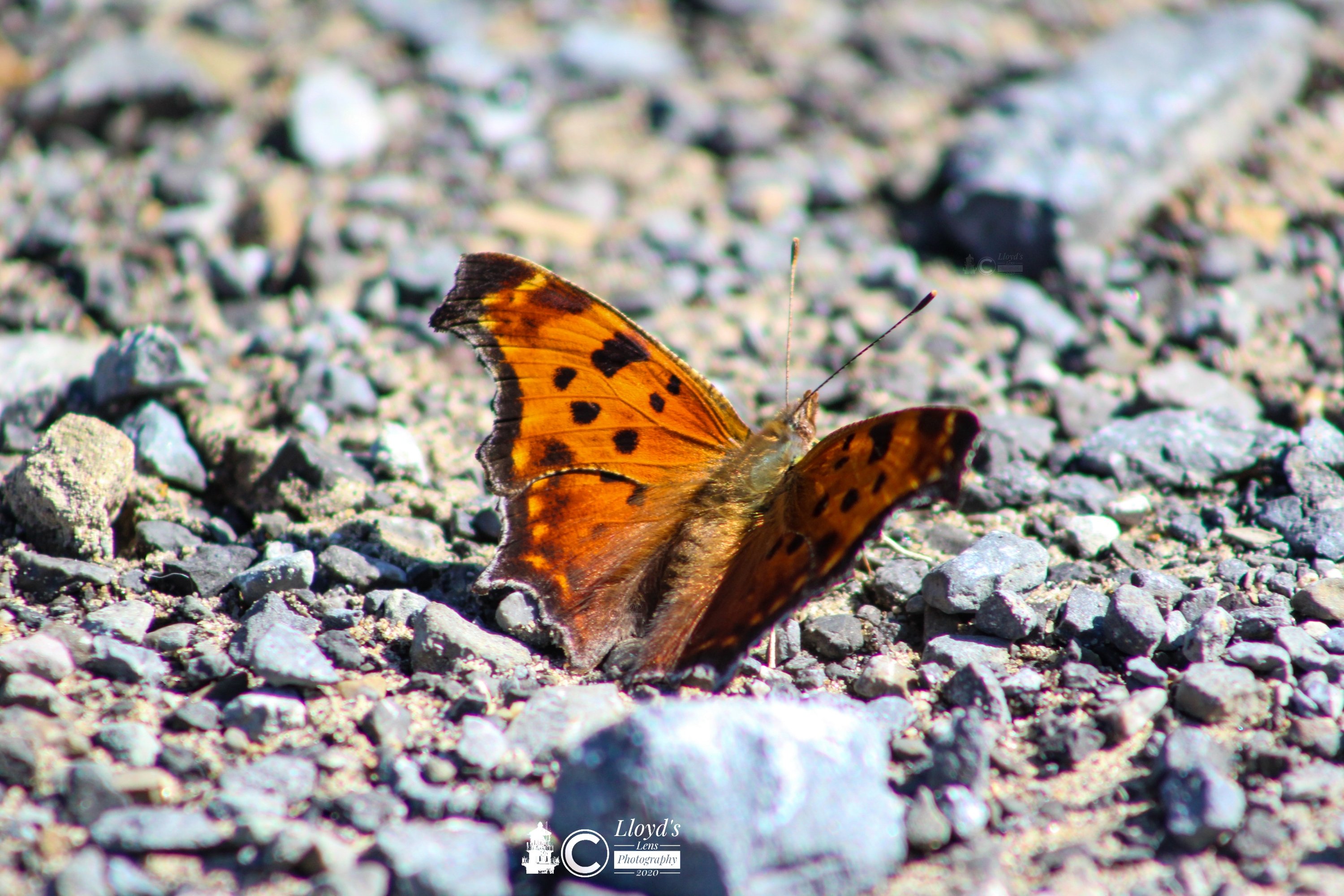
The October sun reaches its zenith as the big blue truck rolls to a stop on Muddlety Creek. Running errands has become a bit of a double duty for me. It’s a chance to to get off my mountain and get some variety of scenery. I’ve come to the spot where the old barn slowly fades into the past. I fear that the end is near for her but I digress. If the mind has an eye that shows us worlds just beyond perception then the heart has an ear that listens to the story of those worlds. The old barn speaks in whispers so your heart has to open wide to hear her. As I tuned my heart to listen to the old barn I distinctly heard a different voice giggling playfully. The giggle came from a dead leaf off to my left and was causing the barn to pause her story. I lowered my lens and before I could take a step to see what this giggler was up to the wings slowly opened to reveal the beautiful orange colored wings of Wood Nymph Butterfly. Abandoning her perfect perch on a twig she launched herself my direction and circled my head before landing at my feet and displaying her magnificent wings. Her pattern was nearly identical to her cousin the Question Mark Butterfly. “Are you a.. Comma Butterfly?” I asked softly. The butterfly slowly folded her wings and revealed that identifying mark.
Image Titled “Comma Butterfly 100620a” and is available for purchase by clicking the thumbnail and reaching out to me on the contact page.
She couldn’t couldn’t help but to cause a pause in the conversation between the old barn and I. After all, she is a Comma Butterfly.
While the Patty Duke Show is a little before my time I had heard the theme song and while looking at the pictures of the two butterflies that song kept playing in my head.
So let’s take a look at two and how we can tell them apart.
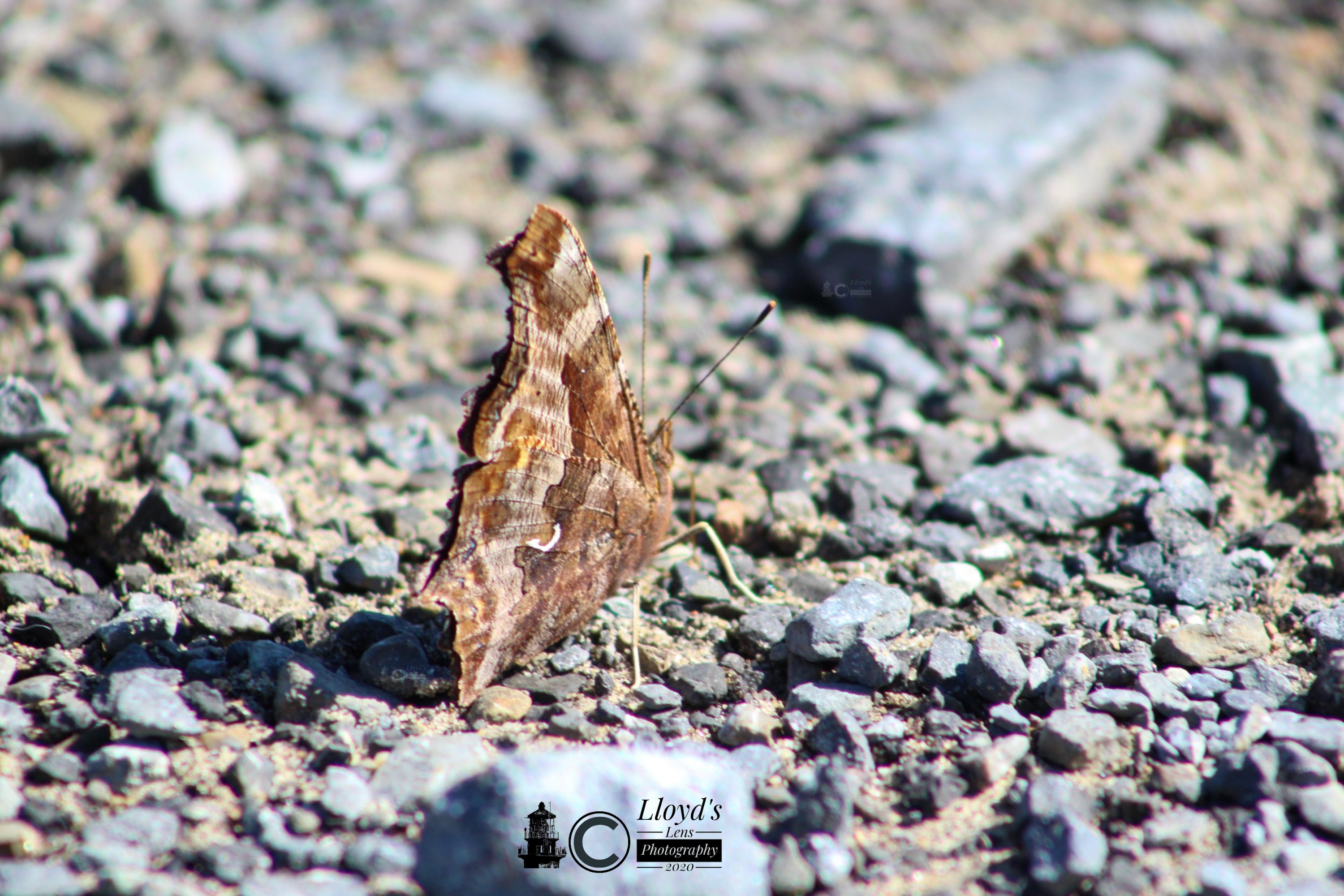
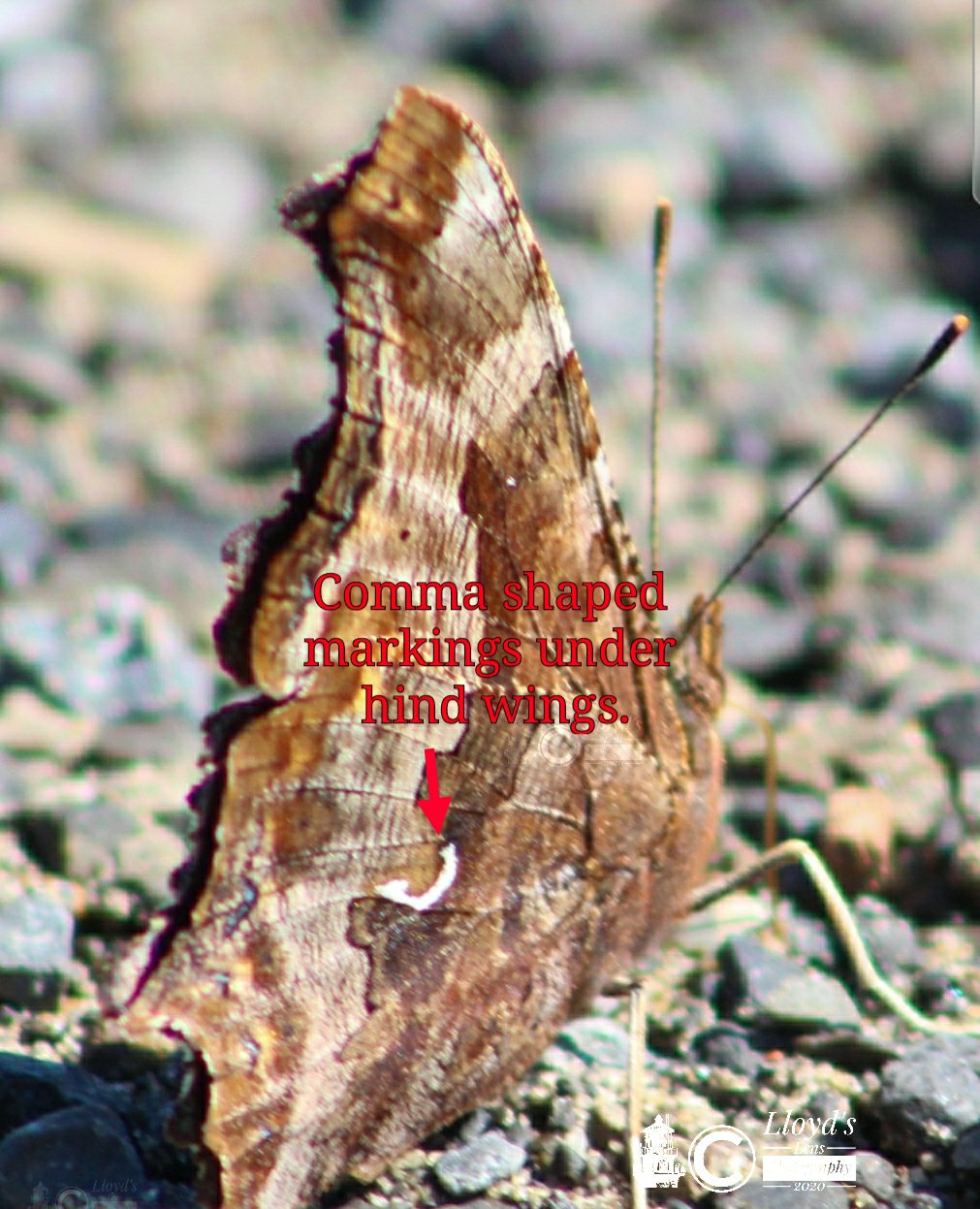
I’ll start with a blown up version of the underside of the Comma Butterfly wing.
Comma Butterfly wing details
The Comma Butterfly had a mottled brown pattern underneath where the pattern of the Question Mark Butterfly was bluish Grey but that color may not be consistent in all individuals. It’s very possible that the tone may vary like hair color but I hadn’t really looked that deep. The one thing that the guides agree on is the silvery spots. In the Question Mark Butterfly this spot is followed by a silver dot that forms the “?”. Comma Butterflies never have the dot. Unfortunately I was not able to get a picture of the underside of the Question Mark Butterfly but there’s plenty of examples online.
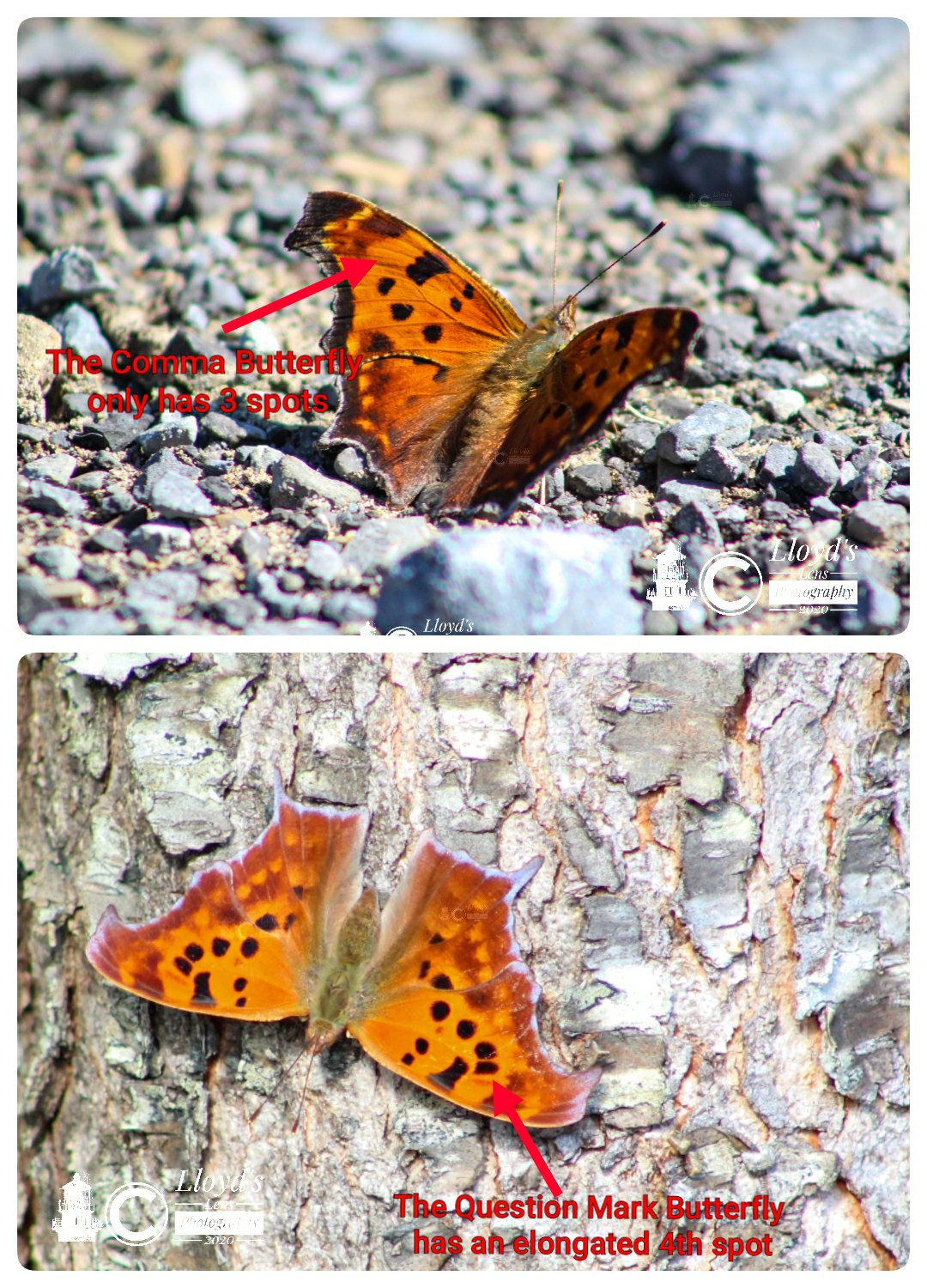
The upper side of forewing has a distinctive mark as well as seen on the next image.
The top butterly is a Comma Butterfly. The wing pattern has three black dots in a row. The other marks might be different from one individual to the next but a Comma Butterfly always has just three dots. The bottom image is from last night’s post and shows the Question Mark Butterfly. The Question Mark Butterfly will have the three dots but is always followed by a fourth elongated mark near the margin. I also noticed that the Question Mark Butterfly is lighter in color but again that could be individual genetics and not a difference between species. The information I have immediate access to is pretty basic and doesn’t really go beyond the dots on top and the silvery spots underneath. As I mentioned before they are both Wood Nymph Butterflies as is the silver spotted skipper I featured throughout the Summer. I’m not sure if they are specifically cool weather Butterflies or not but they do seem to have more fur than the Swallowtail Butterflies I see the most of.
Running into a Comma Butterfly so soon after the Question Mark Butterfly was really fortunate. They were about 15 miles apart. The Question Mark Butterfly was near Summersville Lake and the Coma Butterfly was near the edge of the marsh. Both were on the edge of woodlands which is something else that the guides agree on.
So as the season continues to change keep an eye on those ragged edged dead leaves. One just might open up and come to life in brilliant colors.
That’s it for tonight. Be blessed throughout your day friends!
Hey Friends! Just a quick reminder that Lloyds Lens Photography is available for portraits!
Tobook me simply reach out using theContact Pageand we’ll set a date. If you’re within a 50 mile radius of Summersville West Virginia all travel fees are waived.
If you would like to Follow me on Facebook the web address is
I’m now using Zazzle to fulfil orders. What this means for you is a secure way to place an order, discount codes & a broader product selection! Simplymessage me on Facebookoruse the contact form on my websiteand tell me which image you want and I’ll reply with a direct link to where you can place the order.
Lastly, all of the photos and writings are my original work unless otherwise specified and are not to be copied or reproduced without expressed written permission from the photographer







 LLOYD'S LENS PHOTOGRAPHY LLC