Daily Duties

Hello Friends! Tonight’s feature image is titled “Daily Duties” and is available for purchase by following the instructions at the bottom of the article.

The soft morning rain slowed to a gentle mist as the big blue truck eased to side of the road. The green landscape is peppered with little blue pops of chicory bloom. The marshland bustles with hidden life. The ducks are navigating the current just beyond that sea of cattails. Within the cattail red-winged blackbirds continue to call as they gather twigs to refresh their nests. The next sounds that I hear is the deep droning of bumblebees playing in the Swamp Rose. We’re getting close to then of their season and the bees are frantically trying to collect the last of the rose pollen. Then I noticed movement in the nearby chicory blossoms. Sometimes very small. Something that looks like a flying gemstone. The metallic green colors and pollen packs on its legs told me it’s a mason bee. Sadly, the pollen it collects does not become honey. Instead of honey the mason bee makes little pollen cakes.

I’m pretty new to mason bees. I knew that they existed and that in some parts of the world they are the main pollinators. I also knew that they are among the most gentle bees in the world. Only the female mason bee has a stinger and even then you pretty much have to force them to sting.

Unlike honey bees the mason bees do not live in a hive. They will form colonies but they don’t have a collective. Instead they are solitary.

Mason bees nest in tubes and cap each cell of the tube with a mud brick. This of course is how they got their name. Similar to the mud dauber wasps nests each cell in the tube will contain a single egg and a pollen cake. The young will have to break out of the cell in order to survive. But unlike the mud dauber wasps the mason bee does not construct it’s own tube. Instead it’s opportunistic. It will take advantage of the holes left behind by wood boring beetles or a crevice in the rocks and so forth. In cultures that traditionally rely on the mason bee for crop production blocks of wood are drilled with several holes to give them a place to nest. A quick search on Pinterest show just how artistic and diverse the mason bee habits are created. They are also a wide variety of mason bee subspecies and I am honestly unsure of which kind is in the feature image. I do know that prior to European honeybees being brought into North America that major amount Native American horticulture would have relied on bumblebees and Mason bees. ( contrary to the movies Native Americans in pre-columbian times were not strictly hunter gatherers. )

During the colony collapse disorder a few years ago I noticed a sharp rise in native bees pollinating the wildflowers near my home.

I followed the little green bee from flower to flower snapping photos and trying to catch her in just the right spot. When she finally allowed herself to be caught in the lens I moved off and gave her space to complete her daily duty of making pollen cakes for her babies.

Hello Friends and thank you for your support of my page. If you have enjoyed the photos or the writings please let me know by commenting and sharing my work on your social media. I also want to invite you to Follow Lloyds Lens Photography on Facebook

If you would like to Follow me on Facebook the web address is

https://www.facebook.com/aviewfromthelens/

If you’re enjoying my blog and don’t want to miss a post then you can sign up for email alerts on my website.

https://lloydslensphotographyllc.com/

Click here to visithttps://lloydslensphotographyllc.com/

Did you know that I also do portraits by appointment? If you’re interested in a portrait session either message me on Facebook or Use the Contact form. The YouTube link below takes you one of my slideshows.

https://youtu.be/FDcrY6w8oY8

Have you checked out the Zazzle Store?

I’m now using Zazzle to fulfil orders. What this means for you is a secure way to place an order, discount codes & a broader product selection! Simply message me on Facebook oruse the contact form on my websiteand tell me which image you want and I’ll reply with a direct link to where you can place the order.

Clicking on the photo takes you tohttps://www.zazzle.com/lloydslensphotos?rf=238248269630914251

Lastly, all of the photos and writings are my original work unless otherwise specified and are not to be copied or reproduced without expressed written permission from the photographer.

Thank you again for your support of my page!❤

Snowberry Clearwing

Hello Friends! Tonight’s feature image is titled “Snowberry Clearwing on Butterfly Bush” and is available for purchase by following the instructions at the bottom of the article.

I’m still searching for the Spicebush Swallowtail. And I still haven’t gotten a confirmed photo of what is said to be common to my area. As I was driving though the Kanawha Falls area I noticed a large butterfly bush near the side of the road. I brought my big blue truck to a screeching halt in the gravel and grabbed my trusty DMC-FZ30 Panasonic Lumix. I searched the butterfly bush for several minutes. The bush seemed to be abandoned at first. But then something large emerged from the other side of the bloom. It moved like a hummingbird but had the colors of a large bumblebee. It had the tail of a lobster and extended a long proboscis like a butterfly. It hovered in place sipping netar by probing each little bloom individually. It’s not butterfly at all. It’s a moth.

The Clearwing Hawk Moth is the day walker if the moth community. It’sresemblance to a bumblebee gives it a certain level of protection from most predators. They come in beautiful colors and a little farther North is a variety with bright red trim on its wings.

A refreshed edit of an earlier published image shows the Snowberry Clearwing On Multiflora Rose.

The variety that I’m the most familiar with is the Snowberry Clearwing Moth. Although they get their name from hosting on wild snowberry they also host on Dogbane (also known as Indian Hemp) and they can be a pest on fruit trees. In the adjoining image the Snowberry Clearwing is resting on a Multiflora Rose.

They’re mostly active during the day which makes me wonder how they navigate. Moths gather around your porch light because they navigate by keeping their bodies at a certain angle to the moon. When they encounter an artificial light they assume that the brightest light is the moon and adjust accordingly. But because the sun is so bright and not polarized like the moon they must have a way to compensate. But they do continue activity into the night. I have encountered them while walking with a flashlight and the greenish yellow eye shine is a little confusing the first time that you see it. The first time that you see one in daylight your first thought is “Whoa! Big Bee” and is sometimes accompany buy high-pitch squealing.

A quick Google search shows that the USDA considers the Snowberry Clearwing Moth a pollinator. When you notice how thick it’s fur is then it makes perfect sense that some pollen will be transferred as it hovers around from bloom to bloom.

One of strangest names for these moths is “Flying Lobster” and that name seems to come from my home state of West Virginia. The only photo that I have that shows the fan shaped tail that this class of moths share is a variety with a bright yellow body and brown bands that resembles a Yellowjacket wasp more than a bumblebee.

This Clearwing Hornet Moth looks like a Yellowjacket but has the same “lobster tail” that is not visible in the other photos.

Once again Google came to my rescue and gave the ID on this Clearwing Moth. This one is even capable of mimicking the hornet’s flight patterns. Something that I can verify myself because when I took the picture with my cellphone the insect lifted off and charged me pulling away at the last minute just like a hornet would. It’s bluff works. My reflexes took over and I ducked to avoid being stung.

I might have missed out on the Spicebush Swallowtail again but the excursion will go in the win column since I got a few shots of one of Appalachia’s interesting pollenators.

The big blue truck is still idling with the door open as the moth in the first image hovers over to a new plant. It’s time to tuck the camera back into its holster and leave the gravel in favor of the road home.

Hello Friends and thank you for your support of my page. If you have enjoyed the photos or the writings please let me know by commenting and sharing my work on your social media. I also want to invite you to Follow Lloyds Lens Photography on Facebook

If you would like to Follow me on Facebook the web address is

https://www.facebook.com/aviewfromthelens/

If you’re enjoying my blog and don’t want to miss a post then you can sign up for email alerts on my website.

https://lloydslensphotographyllc.com/

Click here to visithttps://lloydslensphotographyllc.com/

Did you know that I also do portraits by appointment? If you’re interested in a portrait session either message me on Facebook or Use the Contact form. The YouTube link below takes you one of my slideshows.

https://youtu.be/FDcrY6w8oY8

Have you checked out the Zazzle Store?

I’m now using Zazzle to fulfil orders. What this means for you is a secure way to place an order, discount codes & a broader product selection! Simply message me on Facebook oruse the contact form on my websiteand tell me which image you want and I’ll reply with a direct link to where you can place the order.

Clicking on the photo takes you tohttps://www.zazzle.com/lloydslensphotos?rf=238248269630914251

Lastly, all of the photos and writings are my original work unless otherwise specified and are not to be copied or reproduced without expressed written permission from the photographer.

Thank you again for your support of my page!❤

Pipevine Swallowtail

Hello Friends! Tonight’s feature image is titled “Pipevine Swallowtail 62416” and is available for purchase by following the instructions at the bottom of the article.

I am still on the hunt for a Spicebush Swallowtail. What I didn’t account for was the number of look-alikes that dwell in the Appalachian Mountains. The more that read up on the differences between the Swallowtail Butterflies the more that I’ve had to go back and check references as I sort through my photos. I have Spicebush on my property. I have taken lots of butterfly pictures. There should be at least one of the Spicebush Swallowtail. What I’ve discovered is that the majority of black and blue photos that I have are of the Pipevine Swallowtail.

The online guides all show that a major distinction between the two species is that the abdomen of the Pipevine Swallowtail is blue.

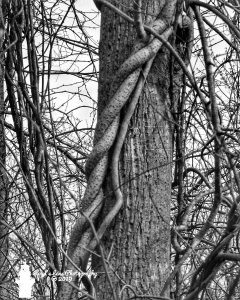
Pipevine Swallowtails get their name from the fact that they host on pipevine which is also known as Camphor Vine.

A twisted camphor vine in Kanawha County West Virginia.

As the larvae feeds on the Pipevine it sequesters certain chemicals in the vine that makes it taste horrible to predators. Or so the experts say. I’m not a bit envious of the scientists who had to test that theory. 🤢

The males are know to collect and accumulate sodium from the mud as a gift to bribe the female with. Wikipedia says that this is most common in presence of other rival males. I checked and found that I have a photo of this behavior.

I believe that this photo shows two male Pipevine Swallowtails gathering sodium from the mud while a female in the middle waits to see who has the better gift.

An insect’s nervous system is dependent on the same mineral balance as a human. But they can’t can’t really get everything they need from nectar. So butterflies and some others look for those dissolved minerals in wet places.

Trying to get a good shot of a butterfly has proven to be a little bit of challenge. I stepped out of the house yesterday to find a blue and black Swallowtail zooming around my yard like a jet fighter. Even using the same technique that I’ve used to photograph athletes failed to provide a positive ID on the butterfly.

This is a blue and black Swallowtail coming in low like a jet fighter but I still can’t get a positive ID on which kind.

I needed a good look at the underside of the wings. I followed the behavior pattern of this particular butterfly and noticed that it seemed to be flying a figure eight pattern as it searched for nectar. I anticipated it’s next loop and keeping my camera in burst mode I managed to get a shot in the underside of the wings.

I managed to catch the underside of the wings as the butterfly engaged in a breaking maneuver.

The angle of the sun caused the butterfly to be in it’s own shadow but I can make out a single row of dots on the underside of the wings. If this were a Spicebush Swallowtail there would be a double row. The single row of dots and the fact that at least one of the dots is blue and not orange tells me that it’s most likely to be a dark morph of the female Tiger Swallowtail.

And so the search for a Spicebush Swallowtail continues for now. I know that there’s one close by and that I just need to be in the right place at the right time to catch it.

Hello Friends and thank you for your support of my page. If you have enjoyed the photos or the writings please let me know by commenting and sharing my work on your social media. I also want to invite you to Follow Lloyds Lens Photography on Facebook

If you would like to Follow me on Facebook the web address is

https://www.facebook.com/aviewfromthelens/

If you’re enjoying my blog and don’t want to miss a post then you can sign up for email alerts on my website.

https://lloydslensphotographyllc.com/

Click here to visithttps://lloydslensphotographyllc.com/

Did you know that I also do portraits by appointment? If you’re interested in a portrait session either message me on Facebook or Use the Contact form. The YouTube link below takes you one of my slideshows.

https://youtu.be/FDcrY6w8oY8

Have you checked out the Zazzle Store?

I’m now using Zazzle to fulfil orders. What this means for you is a secure way to place an order, discount codes & a broader product selection! Simply message me on Facebook oruse the contact form on my websiteand tell me which image you want and I’ll reply with a direct link to where you can place the order.

Clicking on the photo takes you tohttps://www.zazzle.com/lloydslensphotos?rf=238248269630914251

Lastly, all of the photos and writings are my original work unless otherwise specified and are not to be copied or reproduced without expressed written permission from the photographer.

Thank you again for your support of my page!❤

Tiger Swallowtail

Hello Friends! Tonight’s feature image is titled “Tiger Swallowtail 6319” and is available for purchase by following the instructions at the bottom of the article.

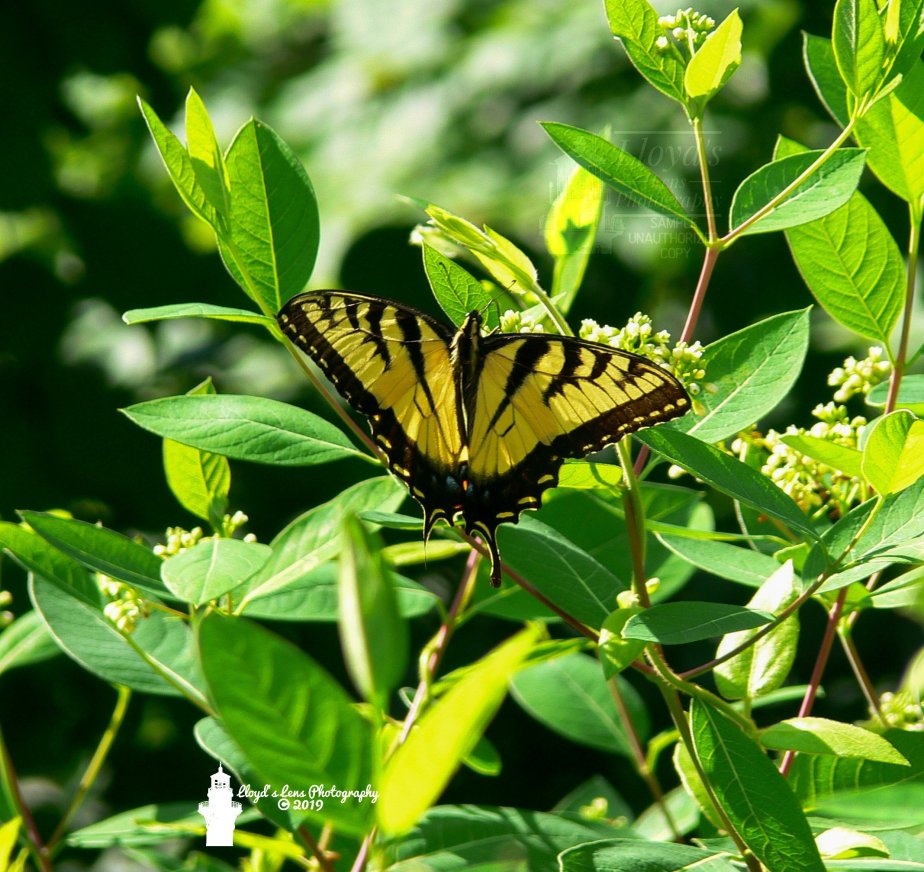
As I continue to watch the swarm of butterflies on the weeds near my day job I’m reminded of the iconic animation of flowers turning into butterflies and filling the air. There was so many colors swirling around that it was a little surreal. The entomology class that I took focused on pest control and we tended to lump all of the Swallowtail Butterflies into one group. And it actually wasn’t until I started researching for this series that I learned of all the subspecies. This one is the Eastern Tiger Swallowtail.

Tonight’s feature image is a male. The males are always yellow and do not have blue spots on the hind wings.

The female Tiger Swallowtail seems to have a diverse wardrobe. That ranges from light yellow to dark black.

A female Tiger Swallowtail ( dark morph).

The female always has blue dots on the lower hind wings and is easy to confuse with the Spicebush Swallowtail. ( The Spicebush Swallowtail will be in an upcoming post)

A notable behavior of the Tiger Swallowtail is puddling. They tend to gather together on the edges of water for a drink. It’s not uncommon for butterflies to get water and minerals this way but it’s only the Tiger Swallowtail that I’ve seen doing this as a group. When I was a teenager I remember one trip to the lake when one of my friends managed to capture several of the Tiger Swallowtails at once. He grinned and slipped beneath the surface taking the butterflies with him. At the time I thought that the butterflies would be harmed but now I know that insects are basically balloons. Their complex respiratory system actually gives them the ability to hold their breath for several minutes. When he released them under water he managed to keep them in a bubble and the sight of the butterflies emerging from the water was pretty spectacular.

With the knowledge of puddling I think that it might be possible to entice the Swallowtail Butterflies to come closer by mixing a salty/sweet solution and soaking a sponge for them to gather on.

I don’t have a picture of the catipiller but it’s kinda special too. The Swallowtail catipiller has a butt that mimics the head of a snake complete with large cartoon eyes!

As we head into summer some of more colorful blooms will the choice food for butterflies of all kinds and I hope to bring you some spectacular images. Have a blessed day everyone!

Hello Friends and thank you for your support of my page. If you have enjoyed the photos or the writings please let me know by commenting and sharing my work on your social media. I also want to invite you to Follow Lloyds Lens Photography on Facebook

If you would like to Follow me on Facebook the web address is

https://www.facebook.com/aviewfromthelens/

If you’re enjoying my blog and don’t want to miss a post then you can sign up for email alerts on my website.

https://lloydslensphotographyllc.com/

Click here to visithttps://lloydslensphotographyllc.com/

Did you know that I also do portraits by appointment? If you’re interested in a portrait session either message me on Facebook or Use the Contact form. The YouTube link below takes you one of my slideshows.

https://youtu.be/FDcrY6w8oY8

Have you checked out the Zazzle Store?

I’m now using Zazzle to fulfil orders. What this means for you is a secure way to place an order, discount codes & a broader product selection! Simply message me on Facebook oruse the contact form on my websiteand tell me which image you want and I’ll reply with a direct link to where you can place the order.

Clicking on the photo takes you tohttps://www.zazzle.com/lloydslensphotos?rf=238248269630914251

Lastly, all of the photos and writings are my original work unless otherwise specified and are not to be copied or reproduced without expressed written permission from the photographer.

Thank you again for your support of my page!❤

The Great Spangled Fritillary

Hello Friends! Tonight’s feature image is titled Spangled “Fritillary And Indian Hemp” and is available for purchase by following the instructions at the bottom of the article.

When I stepped out the door of the office I was greeted by the fluttering of wings. The patch of Indian Hemp was full of butterflies. In fact there was several varieties. I saw little wood nymphs, painted ladies, yellow and black Swallowtail butterflies as well as small blues. I’ll be posting pictures of some of them later but tonight it’s the Great Spangled Fritillary.

Butterflies and moths are host specific. They require certain plants to complete their lifecycles. For the Great Spangled Fritillary butterfly the host plants are native violets. Which means that if you want this type of butterfly then you’ll want to encourage native violets for the catipiller. During the summer months the female Fritillary lays her eggs on the violets but after they hatch they remain dormant until Spring. Only then will they begin to feed on the violet leaves. The catipiller will molt six times before it gets it’s wings! And what beautiful wings they’re going to be! I’m not really certain but I believe that the feature image shows a male. In researching the article I learned that the females are more brown than the male. Either way it’s a beautiful species.

Hello Friends and thank you for your support of my page. If you have enjoyed the photos or the writings please let me know by commenting and sharing my work on your social media. I also want to invite you to Follow Lloyds Lens Photography on Facebook

If you would like to Follow me on Facebook the web address is

https://www.facebook.com/aviewfromthelens/

If you’re enjoying my blog and don’t want to miss a post then you can sign up for email alerts on my website.

https://lloydslensphotographyllc.com/

Click here to visithttps://lloydslensphotographyllc.com/

Did you know that I also do portraits by appointment? If you’re interested in a portrait session either message me on Facebook or Use the Contact form. The YouTube link below takes you one of my slideshows.

https://youtu.be/FDcrY6w8oY8

Have you checked out the Zazzle Store?

I’m now using Zazzle to fulfil orders. What this means for you is a secure way to place an order, discount codes & a broader product selection! Simply message me on Facebook oruse the contact form on my websiteand tell me which image you want and I’ll reply with a direct link to where you can place the order.

Clicking on the photo takes you tohttps://www.zazzle.com/lloydslensphotos?rf=238248269630914251

Lastly, all of the photos and writings are my original work unless otherwise specified and are not to be copied or reproduced without expressed written permission from the photographer.

Thank you again for your support of my page!❤