Hello Friends! Tonight’s feature image is titled “Natural Treasures” and is available for purchase by following the instructions at the bottom of the article.
The morning sun is already started to burn hot as I enter the marsh. I have heard a tale that somewhere in the maze of cattails lives a golden dragon who guards a jewel of great value. The crisp aromas of water mint fills the humid air. Rustling noises on the other side of the thick mat of leaves tells me that the birds are on the hunt. Silvery flashes dart through the water as I make my way towards the goal. Something moves just outside of my field of vision. I turned around but saw nothing. There’s a buzzing sound with a rattling that sounds a little like paper caught in a fan. I moved slowly in the direction of the noise and it moved away. I paused to give the sound a chance to settle. When the sound of papery wings ceased I gently moved the foliage aside and searched the lush green leaves underneath. And there I saw the legend was true. A golden dragon rested on a leaf guarding diamond sphere. I marveled at the shiny body and gossamer wings. Unlike the questing knights of tales told long ago I came not a sword and lance but a lens to capture my quarry. This tiny dragon breathes no fire. No smoke encircled it’s lair. The sun will soon reclaim it’s guarded treasure but it’s legend is forever preserved in my lens.
Hello Friends and thank you for your support of my page. If you have enjoyed the photos or the writings please let me know by commenting and sharing my work on your social media. I also want to invite you to Follow Lloyds Lens Photography on Facebook
If you would like to Follow me on Facebook the web address is
Did you know that I also do portraits by appointment? If you’re interested in a portrait session either message me on Facebook or Use the Contact form. The YouTube link below takes you one of my slideshows.
I’m now using Zazzle to fulfil orders. What this means for you is a secure way to place an order, discount codes & a broader product selection! Simplymessage me on Facebookoruse the contact form on my websiteand tell me which image you want and I’ll reply with a direct link to where you can place the order.
Lastly, all of the photos and writings are my original work unless otherwise specified and are not to be copied or reproduced without expressed written permission from the photographer.
Hello Friends! Tonight’s feature image is titled “Something Fishy” and is available for purchase by following the instructions at the bottom of the article. The reflections are 100% natural.
Every lake has it’s legends. Scotland has Nessie, Lake Champlain boasts of Champ and the ancient Greeks told of the Kraken. But deep down beneath the surface of Summersville Lake something glides through the sunken town of Gad. The light doesn’t penetrate down there so the creature must prefer the darkness. I’ll never forget trolling up to one of the larger houseboats on the lake one summer morning and being shown the large ocean rig snapped off at base and a large hook that was pulled out straight. I may have even caught a glimpse of the scaly beast a few days later when a sudden swirl of water swallowed up an eighteen inch long copperhead. We motored over for a better look but only found the serpent’s head as it slowly disappeared into the murky depths. A local diver is said to be the only person who came face to face with the monster fish and lived to tell the tale of the giant catfish in Summerville Lake.
Just like in any good tale of a legendary beast there’s a bit of controversy. Some people say that it’s all wild imagination. The ocean rod and hook could have snagged a log or large rock under the water. The diver could have been closer to a large but normal sized fish than he thought. The pictures in the local dive shop could be a forced perspective. ( objects closer than they appear. ) But then again. The lake is 300 feet deep in the summer. The lake covers over 2,700 acres and has over 60 miles of shoreline. If that’s not enough space to hide a monster then there’s also submerged caves.
This is one of caves in Summerville Lake that is said to shelter a giant catfish. During the summer it’s well below the water line.
The cave pictured here has an opening about the size of a small garage door. The picture was taken during winter when the lake had been drained. There’s plenty of room in there for an abnormal sized fish to hide.
I know what some of you are thinking. “If they drain the lake every year then why isn’t there a giant catfish laying in the mud?” The answer is that they don’t fully drain the lake. I don’t exactly know what the depth is at winter pool but it’s still pretty deep.
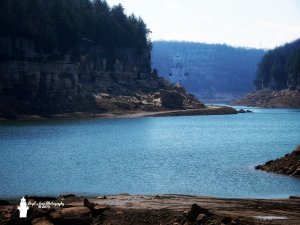
Summerville Lake at winter pool is still a large body of water.
In the next photo we see Summersville Lake at winter pool. In the frame you can see the old road that once lead to the town of Gad.
I have written before that the Corps Of Engineers nearly named the lake after the town of Gad. Which would have made it Gad Dam Lake and any giant catfish living in the lake a Gad Dam monster. ( since I only post pictures that I’ve taken myself here is a link to story of Gad including photos from the past. Underwater Ghost Town )
Until someone actually manages to haul a 300 pound catfish up from the sunken town of Gad it will remain in realm of legend. In the meantime, I have the natural illusion of a giant fish made by a cluster of fallen trees in the Salmon Run area of Summersville Lake.
So now I have to ask. Do you have a legend of giant fish where you live?
Hello Friends and thank you for your support of my page. If you have enjoyed the photos or the writings please let me know by commenting and sharing my work on your social media. I also want to invite you to Follow Lloyds Lens Photography on Facebook
If you would like to Follow me on Facebook the web address is
Did you know that I also do portraits by appointment? If you’re interested in a portrait session either message me on Facebook or Use the Contact form. The YouTube link below takes you one of my slideshows.
I’m now using Zazzle to fulfil orders. What this means for you is a secure way to place an order, discount codes & a broader product selection! Simplymessage me on Facebookoruse the contact form on my websiteand tell me which image you want and I’ll reply with a direct link to where you can place the order.
Lastly, all of the photos and writings are my original work unless otherwise specified and are not to be copied or reproduced without expressed written permission from the photographer.
Hello Friends! Tonight’s feature image is titled “Daily Duties” and is available for purchase by following the instructions at the bottom of the article.
The soft morning rain slowed to a gentle mist as the big blue truck eased to side of the road. The green landscape is peppered with little blue pops of chicory bloom. The marshland bustles with hidden life. The ducks are navigating the current just beyond that sea of cattails. Within the cattail red-winged blackbirds continue to call as they gather twigs to refresh their nests. The next sounds that I hear is the deep droning of bumblebees playing in the Swamp Rose. We’re getting close to then of their season and the bees are frantically trying to collect the last of the rose pollen. Then I noticed movement in the nearby chicory blossoms. Sometimes very small. Something that looks like a flying gemstone. The metallic green colors and pollen packs on its legs told me it’s a mason bee. Sadly, the pollen it collects does not become honey. Instead of honey the mason bee makes little pollen cakes.
I’m pretty new to mason bees. I knew that they existed and that in some parts of the world they are the main pollinators. I also knew that they are among the most gentle bees in the world. Only the female mason bee has a stinger and even then you pretty much have to force them to sting.
Unlike honey bees the mason bees do not live in a hive. They will form colonies but they don’t have a collective. Instead they are solitary.
Mason bees nest in tubes and cap each cell of the tube with a mud brick. This of course is how they got their name. Similar to the mud dauber wasps nests each cell in the tube will contain a single egg and a pollen cake. The young will have to break out of the cell in order to survive. But unlike the mud dauber wasps the mason bee does not construct it’s own tube. Instead it’s opportunistic. It will take advantage of the holes left behind by wood boring beetles or a crevice in the rocks and so forth. In cultures that traditionally rely on the mason bee for crop production blocks of wood are drilled with several holes to give them a place to nest. A quick search on Pinterest show just how artistic and diverse the mason bee habits are created. They are also a wide variety of mason bee subspecies and I am honestly unsure of which kind is in the feature image. I do know that prior to European honeybees being brought into North America that major amount Native American horticulture would have relied on bumblebees and Mason bees. ( contrary to the movies Native Americans in pre-columbian times were not strictly hunter gatherers. )
During the colony collapse disorder a few years ago I noticed a sharp rise in native bees pollinating the wildflowers near my home.
I followed the little green bee from flower to flower snapping photos and trying to catch her in just the right spot. When she finally allowed herself to be caught in the lens I moved off and gave her space to complete her daily duty of making pollen cakes for her babies.
Hello Friends and thank you for your support of my page. If you have enjoyed the photos or the writings please let me know by commenting and sharing my work on your social media. I also want to invite you to Follow Lloyds Lens Photography on Facebook
If you would like to Follow me on Facebook the web address is
Did you know that I also do portraits by appointment? If you’re interested in a portrait session either message me on Facebook or Use the Contact form. The YouTube link below takes you one of my slideshows.
I’m now using Zazzle to fulfil orders. What this means for you is a secure way to place an order, discount codes & a broader product selection! Simplymessage me on Facebookoruse the contact form on my websiteand tell me which image you want and I’ll reply with a direct link to where you can place the order.
Lastly, all of the photos and writings are my original work unless otherwise specified and are not to be copied or reproduced without expressed written permission from the photographer.
Hello Friends! Tonight’s feature image is titled “Swamp Rose 62919A” and is available for purchase by following the instructions at the bottom of the article.
My big blue truck rolls down the quiet country road in Nicholas County West Virginia. I have come to check out what might be happening in the marshland of Muddelty Creek. As the dust from the road thins into breeze I can hear the Red-winged Blackbirds. The calls seem to come from everywhere. I look out among the cattails and bullrush in search of one of the singers. The landscape is full of pink dots all throughout the delta.
A red-winged blackbird perched in a sea of Swamp Rose.
The pink dots are one of the simple beauties of the marshland. They are the native Swamp Rose. Swamp Rose is native to the Appalachian Mountains. Knowing that roses in general have many traditional uses for food and medicine I’m sure that they were important to Native Americans. In my imagination I can see a birch bark canoe silently glide through the marsh as one of the occupants casts tobacco leaves onto the surface in payment for the rose products collected.
It’s not hard to imagine that a native canoe is gliding through the water.
The beautiful and serene setting is one that I could visit on a daily basis if life’s circumstances allowed. And in truth I have wished that there was a public boardwalk that one could take to reach deeper into the landscape.
This little marsh is kinda rare in my mountains. In most places the landscape is not level enough to form this kind of delta. At one point this would have been the home of whooping cranes and herons. The herons are occasionally spotted but I haven’t seen or heard a whopping crane since the early 1970s. However that unique call may once again echoe through the Appalachian Mountains. If we can preserve the wetland areas that they rely on.
Earlier this year I captured a photo that while beautiful represents a danger to the ecology of this marsh.
The Yellow Flag is a warning that native species are in danger of being crowded out.
The color of the invasive Iris is the same color of a warning flag. In fact this European plant is commonly call “Yellow Flags”. As I researched the plant it became painfully obvious that it’s beauty is it’s only desirable quality. In spite of a posts stating that it’s been used as a medical plant the warnings were so numerous and dire that I have no plans to ever even touch the plant. And that’s in fact one of the warnings is that it can cause a severe rash in some people. But the biggest problem is that it completely overwhelms everything else in the swamp. Once established it grows so thick that you can stand on it. It’s thick enough to prevent native species from germinating and thus plants like the native Swamp Rose are choked out. The seeds are prolific and spread for miles because they float downstream. In some cases herbicides are used to control the spread but I’m dubious as to the safety of that action towards the aquatic life. Normally what’s required is physical labor to chop out and remove the whole plant along with the soil it’s growing in. It’s also likely to be a plan that has to be repeated occasionally because they come back from any piece of root left behind. And as they spread they clog the waterways and block migration of fish.
What is needed is a conservation club that can go into these areas and restore the environment under the guidance of a qualified expert. Perhaps the DNR would be needed because of the impact of such drastic measures.
I walked back to my big blue truck as these things weigh on mind. The Yellow Flag was brought here by people who wanted to add something beautiful to their landscapes. I took a second glance at wild Swamp Rose with it’s pink pedals and edible fruit and I can’t help but wonder why it was overlooked by those people.
It’s a much better idea to work with native species in landscapes.
Working with native species in landscapes can be rewarding. Using plants like the Swamp Rose or Cattail not only yields a beautiful landscape but also a food source. Rose hips were made into jams in Victorian times. The flowers are strong scented and in bloom for six weeks while the Iris flowers last three weeks on the average and produce no food.
Turning the key brings the big blue truck to life and I drift slowly back to the main road on my way towards the next photo and the next adventure.
Hello Friends and thank you for your support of my page. If you have enjoyed the photos or the writings please let me know by commenting and sharing my work on your social media. I also want to invite you to Follow Lloyds Lens Photography on Facebook
If you would like to Follow me on Facebook the web address is
Did you know that I also do portraits by appointment? If you’re interested in a portrait session either message me on Facebook or Use the Contact form. The YouTube link below takes you one of my slideshows.
I’m now using Zazzle to fulfil orders. What this means for you is a secure way to place an order, discount codes & a broader product selection! Simplymessage me on Facebookoruse the contact form on my websiteand tell me which image you want and I’ll reply with a direct link to where you can place the order.
Lastly, all of the photos and writings are my original work unless otherwise specified and are not to be copied or reproduced without expressed written permission from the photographer.
Hello Friends! Tonight’s feature image is titled “Snowberry Clearwing on Butterfly Bush” and is available for purchase by following the instructions at the bottom of the article.
I’m still searching for the Spicebush Swallowtail. And I still haven’t gotten a confirmed photo of what is said to be common to my area. As I was driving though the Kanawha Falls area I noticed a large butterfly bush near the side of the road. I brought my big blue truck to a screeching halt in the gravel and grabbed my trusty DMC-FZ30 Panasonic Lumix. I searched the butterfly bush for several minutes. The bush seemed to be abandoned at first. But then something large emerged from the other side of the bloom. It moved like a hummingbird but had the colors of a large bumblebee. It had the tail of a lobster and extended a long proboscis like a butterfly. It hovered in place sipping netar by probing each little bloom individually. It’s not butterfly at all. It’s a moth.
The Clearwing Hawk Moth is the day walker if the moth community. It’sresemblance to a bumblebee gives it a certain level of protection from most predators. They come in beautiful colors and a little farther North is a variety with bright red trim on its wings.
A refreshed edit of an earlier published image shows the Snowberry Clearwing On Multiflora Rose.
The variety that I’m the most familiar with is the Snowberry Clearwing Moth. Although they get their name from hosting on wild snowberry they also host on Dogbane (also known as Indian Hemp) and they can be a pest on fruit trees. In the adjoining image the Snowberry Clearwing is resting on a Multiflora Rose.
They’re mostly active during the day which makes me wonder how they navigate. Moths gather around your porch light because they navigate by keeping their bodies at a certain angle to the moon. When they encounter an artificial light they assume that the brightest light is the moon and adjust accordingly. But because the sun is so bright and not polarized like the moon they must have a way to compensate. But they do continue activity into the night. I have encountered them while walking with a flashlight and the greenish yellow eye shine is a little confusing the first time that you see it. The first time that you see one in daylight your first thought is “Whoa! Big Bee” and is sometimes accompany buy high-pitch squealing.
A quick Google search shows that the USDA considers the Snowberry Clearwing Moth a pollinator. When you notice how thick it’s fur is then it makes perfect sense that some pollen will be transferred as it hovers around from bloom to bloom.
One of strangest names for these moths is “Flying Lobster” and that name seems to come from my home state of West Virginia. The only photo that I have that shows the fan shaped tail that this class of moths share is a variety with a bright yellow body and brown bands that resembles a Yellowjacket wasp more than a bumblebee.
This Clearwing Hornet Moth looks like a Yellowjacket but has the same “lobster tail” that is not visible in the other photos.
Once again Google came to my rescue and gave the ID on this Clearwing Moth. This one is even capable of mimicking the hornet’s flight patterns. Something that I can verify myself because when I took the picture with my cellphone the insect lifted off and charged me pulling away at the last minute just like a hornet would. It’s bluff works. My reflexes took over and I ducked to avoid being stung.
I might have missed out on the Spicebush Swallowtail again but the excursion will go in the win column since I got a few shots of one of Appalachia’s interesting pollenators.
The big blue truck is still idling with the door open as the moth in the first image hovers over to a new plant. It’s time to tuck the camera back into its holster and leave the gravel in favor of the road home.
Hello Friends and thank you for your support of my page. If you have enjoyed the photos or the writings please let me know by commenting and sharing my work on your social media. I also want to invite you to Follow Lloyds Lens Photography on Facebook
If you would like to Follow me on Facebook the web address is
Did you know that I also do portraits by appointment? If you’re interested in a portrait session either message me on Facebook or Use the Contact form. The YouTube link below takes you one of my slideshows.
I’m now using Zazzle to fulfil orders. What this means for you is a secure way to place an order, discount codes & a broader product selection! Simplymessage me on Facebookoruse the contact form on my websiteand tell me which image you want and I’ll reply with a direct link to where you can place the order.
Lastly, all of the photos and writings are my original work unless otherwise specified and are not to be copied or reproduced without expressed written permission from the photographer.





 LLOYD'S LENS PHOTOGRAPHY LLC