

Please remember that Forage Friday is presented as trivia and not to be mistaken for medical advice.
I suppose that my first knowledge of Chaga came from reading about Otzi the Ice Man. Otzi lived around 3300 BC and was found in 1991 as the oldest and most well preserved natural mummy. What was even more amazing was that he was found with most of his kit which included a chunk of chaga mushroom.
Chaga is an extremely versatile fungus for humans and the many things that it gives us would have made it indispensable for a Bronze Age nomad living in the Alps. It is food, tool and medicine. I’ve heard it said that without chaga and a few others like it that the seeds of civilization could have never been sown.
Now if you search the internet you’ll find a lot of mythos concerning chaga. Some of it I deem to be true and some of it is complete bunk. Let’s start with the myth that it’s only found in the Artic Circle. I live in Sout Central West Virginia well away from the tundra and the photos taken for this article were taken a very short drive from my home. In fact I could have walked there if I’d been determined enough. The second myth is that chaga is only found on Birch. While I’ve never actually found it on Hornbeam myself I have seen photos and videos of chaga growing on Hornbeam and its said to have been found on oak and cherry. The value of any of this type of fungus comes from the host. One of the videos I reviewed warns that chaga found on cherry is toxic because it concentrates the cyanide naturally found in cherry bark. So I do recommend that you make sure that you have chaga that is on a birch tree and not a cherry tree. One good way to do that is with the faces method that I laid out in Forage Friday #99 last week. As for the chaga found on Hornbeam and Oak I’m unsure. Almost everything I have reviewed says that part of Chaga’s amazing superfood status comes from polyphenol and complex polysaccharides that it builds from the birch bark and ultimately from the soil quality that the birch is growing in. When I took my forestry training we classified it as a disease that ruined the lumber value of birch. A lot of the youtubers claimed it was a symbiotic fungus. I have to go with the parasite/disease theory because the fungus enters the tree through a wound and ultimately causes deformed growth. But with the caveat that it’s to the benefit of the fungus to prolong the death of the trees and therefore it’s probably doing something that helps keep the trees alive.
Okay, that’s enough of the technical stuff. Let’s get to foraging this fungus.
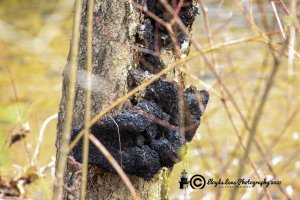
Image Titled “Chaga On Yellow Birch 32321a”.
Chaga is always found near water. Even if you don’t see a stream it’s a safe bet that there is an underlying water source beneath the ground. So forage Chaga in the low areas and along streams. It’s also a safe bet that if you find one that there’s more close by. It’s pretty easy to spot because it looks like charcoal erupting from the trunk of the trees. As it grows pressure builds up inside the wood and the trees split vertically. You can see that just above the black mushroom that this tree is beginning to split. There’s also a lot of dead wood at the top. We call this kind of tree a widow maker for a reason so take care when working around the bottom.

A well aged birch tree can have bark that resembles Oak at the base.
Let’s pause for a moment and revisit chaga growing on Oak. This is the base of the same tree that’s in the previous photo. When we think of yellow birch we tend to imagine a tight bark with loose papery curls. Well, very old birch and especially diseased birch can develop the same block pattern bark that Oak has. This is one of the reasons for last week’s tree identification post. We’re told that chaga also grows on Oak and maybe it does. But I also know that some people look only at the bark for identification and therefore may get fooled by malformed bark. So look up and if possible look at leaf scar to recognize the “faces”.

The bark pattern of the upper limb of the chaga tree.
This limb is the same tree as the oak-like bark on the base. This looks like a yellow birch pattern but the pinkish color means it could be a river birch. However, that could be a result of the infection of the chaga.
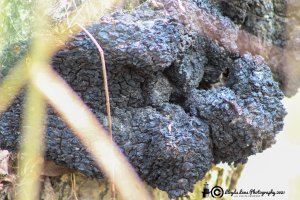
The chaga is mature and ready for harvest.
So once you determine that what you have found is chaga its time to harvest. Harvest can be really easy or really tricky depending on where you find it. Some chaga will come off with just a few bumps from your hand. Others require an axe or large knife to score around the edges first and a few might even need a saw. Typically chaga is harvested in the dead of winter in below freezing conditions. It’s believed that when the sap starts to run that all the benefits of chaga go back into the tree. I have to question that though. The medicinal values of chaga comes from the compounds it makes to benefit itself. If it gives those benefits back to the tree then it loses what it’s gained for itself. This would seem to be counterproductive to the Survival of the fungus. So I think that’s more lore than science.

Image Titled Black Gold Of The Forest 32621b”
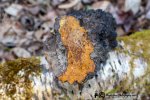
Almost immediately you’ll smell the earthy aroma of the chaga. It’s a scent that’s hard to describe. It’s got a mushroom quality but with a hint of vanilla. The next thing is the color of the interior of the mushroom. This one is more dark amber toned but others are lighter and you’ll see vanes of yellow inside. This is actually the mycelium. In fact, even though we commonly call it a mushroom it’s technically not a mushroom at all. It’s a reproductive structure called a sclerotium. It’s not spores per se. It’s a collection of fungal mass that will become spores at the end of the life cycle. While we’re looking at harvesting let me also make a point about sustainability and bust another myth in the process. It’s common to hear that if you harvest a chaga it kills the tree and the fungus. Well, the chaga appears near the end of the tree’s life. So if you harvest it and the tree dies it was probably about to die anyway and the timing is just coincidence. But, if you leave at least 20% of the fungus in the tree and the tree was going to survive anyway then its only a matter of time before the fungus fruits again. This takes about 5 years. It’s also said that the benefits of chaga go away after the tree dies. But that’s not precisely true either. The fungus has a mission to provide offspring with as much advantage as possible and will continue to mine what it needs from the dead wood.
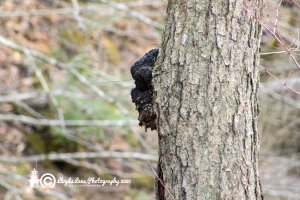
A second chaga growing near the first one.

The top of the second tree turned out to be a birch too.
You could take out your kit and build a fire and enjoy some chaga tea right there in the woods if you wanted. It’s a common practice among bushcrafters and it does add something to the experience. But most people haul a basket of chaga home to process. Keep the black crust. That’s where all of the melanin is. You’ll hear some controversy over the value of the black rind and its components. The claims of curing cancer, treating insulin resistance and restoration of skin elasticity are not really something that I can speak to. However, there are animal studies and tests on lab grown human tissue that indicate that these claims are valid. But, because human trials are expensive and this natural product cannot be given a patent we cannot know for sure. We do know that chaga provides a truckload of nutrients.
Here’s a short list.
B complex vitamins
Vitamin D
Vitamin K
Rubidium
Cesium
Amino acids
Fiber
Copper
Selenium
Zinc
Iron
Manganese
Magnesium
And calcium
According to some researchers chaga has extremely high antioxidants and possibly the highest level in nature.
For those specifics I’m going to refer back to Paul Stamets. This is the same video from the Turkey Tail Fungus post a couple of weeks ago but since some may not have seen it I’ll reference it again.
It’s recommended that you break the chaga into ice cube sized pieces for drying. It can host mold so it’s a good idea to go through the process.
The best option is to use a hammer or a hatchet to do the breaking and you should do this in a box to prevent pieces from flying all over and becoming lost. It’s not really complicated. Just bust it into nuggets.
The drying out should only take a few days and you’ll want to move the nuggets around to get good air flow around them. You can use a dehydrator but you don’t want it any hotter than 140 degrees Fahrenheit. That heat will destroy the polyphenol and complex polysaccharides along with some important enzymes.
Making the tea isn’t to hard. You don’t want it too hot for the same reason why you can’t use the higher settings on a dehydrator. The minimum simmer is around 30 minutes but the longer you cook it then the stronger it gets. I just soaked my first cup in near boiling water for about 15 minutes and got a really mild flavor. But after a little more research here’s the recipe I came up with.
Use spring water or distilled water. Chlorine in tap water is counterproductive to the purpose of chaga tea. Place a handful of nuggets in a crockpot or slow cooker and keep the setting on warm for about 6 hours. The tea will be as dark as coffee but much milder. It also doesn’t get bitter like coffee. If you really want to bring out the flavor add a few drops of natural vanilla to your tea. Traditionally chaga is sweetened with maple or birch syrup. Because the flavor of chaga is already kinda sweet and mild a little goes a long way! It’s easy to overdo it. I like to use locally produced raw and unfiltered honey. The honey is just sweet enough in small portions and has some health benefits of its own to add to the compound. It’s recommended that you only enjoy a cup or so per day but it stores well in the fridge and one Making lasts about a week or so.

One last look at the wonderful chaga!
Now I have to give one last warning ⚠️.
Chaga is known to lower glucose levels and if you’re a type 1 diabetic or on glucose lowering medications you should probably abstain from Chaga.
Chaga is known to thin the blood so if you’re using blood thinners you should probably abstain from Chaga
It’s recommended that if you’re planning surgery that you should inform your doctor that you’ve been consuming Chaga and abstain from it for 2 weeks prior to surgery.
Otherwise Chaga is an awesome forage and it’s more available than popular media has told us. I strongly urge you to look deeper into this one and do plenty of research before thinking about it medicinally. There is a lot to learn and a lot of it good to know.
Announcement 2.0
For those who have been following me on Facebook and know of the struggle content providers have to get circulation from big tech I’ve been recommending for people to adopt MeWe as a social media platform. One of the problems I’ve run into on MeWe is that people don’t know how to navigate the platform. So to help with that I’ve created a permanent page on my website as a basic Basic Beginner’s Guide To MeWe I’ve tried to anticipate all basic questions there and You can bookmark the page to have as a reference and if you have any questions or suggestions don’t hesitate to contact me. I do still have a day job and I help admin several pages on both platforms so replies might be a little slow but I will answer you.
We also have the Lloyd’s Lens Photography Discussion Group on MeWe that is set up as a fully functional community. There you’ll not only be able to see and connect with me but you can also make your own posts and interact with each other.
I want you to join my group on MeWe: https://mewe.com/join/lloydslensphotographydiscussiongroup

Click the link below to jump to the Basic Beginner’s Guide To MeWe.
https://lloydslensphotographyllc.com/guide-to-mewe/
Hey Friends! Just a quick reminder that Lloyds Lens Photography is available for portraits!

To