
Forage Friday #83 Wild Lettuce.

Hello Friends! The photos in tonight’s article were taken specifically for Forage Friday. All photos found on my website are my original work unless otherwise specified and are available for purchase by clicking the thumbnail and reaching out to me on the contact page.

Please remember that Forage Friday is presented as trivia and not to be mistaken for medical advice.

Before we begin I should probably disclose the fact that wild lettuce is one of the plants that I’ve been reluctant to try. One reason why is that I’ve heard conflicting reports about the flavor. Some sing it’s praises while others say it’s horribly bitter. And, because there’s so many other options in the Appalachian Mountains I’ve tucked it away under the “Emergency Use Only” file in my mind. But, I do have a theory that those who say it’s disgusting have harvested it in the wrong stage of life.

It’s stated that domestic lettuce has pretty much been bred to the point where in order to get a more palatable flavor the nutritional value is lost. Wild Lettuce by contrast tends to produce copious amounts of white latex sap and that’s where the awful taste comes from. The sap is more prevalent as the plant matures and thus older plants are more bitter. So to begin with we should only consider the young rosette with new leaves in spring. These should have the least amount of latex and therefore more likely to be acceptable as an edible. Green Dean is one of my go tos on plants that I’m not intimately familiar with. His suggestion is to use wild lettuce as a cooked herb instead of a salad plant as we would domestic lettuce. The recommended method is to boil the tender new leaves for 10 minutes and serve with a vinegar based dressing. I suspect there’s some chemistry at play here. The bitter latex sap would be alkaloid so adding vinegar to bring down the Ph levels should improve the flavor. Again, I’m going on someone else’s word here.

We should also consider that there’s different kinds of wild lettuce just like there’s different kinds of domestic lettuce. This could also affect it’s quality as a wild edible.

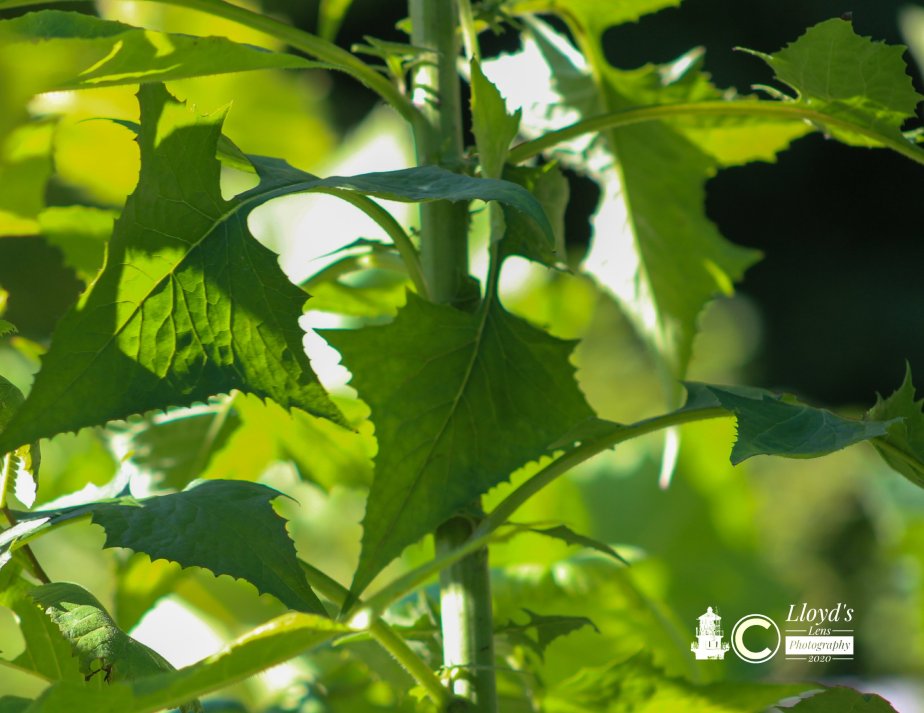
The toothy margin and deep cuts into the leaf are identifying characteristics of wild lettuce.

The plants whose leaves are the subject of tonight’s photos were mature plants about to bloom. One of which I estimated was close to 10 feet tall. I was actually concerned that it might get into the power lines and cut it just in case it might be capable of shorting out the line and starting a fire. When I did it didn’t take long for the stem to produce that sticky latex sap.

When I was taking my early botany classes in the 90s the topic of herbalism came up any time we discussed something that was found locally. While discussing wild lettuce one of my classmates brought up the topic of “lettuce opium”. The gist is that during the Great Depression and prohibition the ingredients for homemade liquor were far too valuable as actual food than as a cocktail. For those who wanted to be intoxicated lettuce opium was a popular choice. The technique involved collecting the sap and reducing it down to a small marble sized ball and smoking it. The deleterious effects may have been nothing more than placebo according to James A Duke of Petersen’s Field Guide and The Green Pharmacy. He stated that “It was a better substitute for latex rubber than opium.” However, there is a tradition of using the substance as a sedative. Like most herbal remedies lettuce opium is credited with helping a broad range of issues. It’s isolates have been used as antimicrobial agents, cough syrup ( probably due to the precieved sedative quality ), various aches and pains and even malaria.

I always try to bring you wild plants that have at least some backing in modern science but to date I’ve not been able to locate a solid conformation of any of these claims. Which is kinda disappointing because it is a plentiful plant. Fortunately for me there are other confirmed plants that provide similar benefits on my mountain and so I’ll be keeping my opinion on wild lettuce as a option only if there’s nothing else available.

Good night friends and be blessed throughout your days.

Hey Friends! Just a quick reminder that Lloyds Lens Photography is available for portraits!

To book me simply reach out using the Contact Page and we’ll set a date. If you’re within a 50 mile radius of Summersville West Virginia all travel fees are waived.

If you would like to Follow me on Facebook the web address is

https://www.facebook.com/aviewfromthelens/

If you’re enjoying my blog and don’t want to miss a post then you can sign up for email alerts on my website.

https://lloydslensphotographyllc.com/

Have you checked out the Zazzle Store?

I’m now using Zazzle to fulfil orders. What this means for you is a secure way to place an order, discount codes & a broader product selection! Simplymessage me on Facebookoruse the contact form on my websiteand tell me which image you want and I’ll reply with a direct link to where you can place the order.

Clicking on the photo takes you tohttps://www.zazzle.com/lloydslensphotos?rf=238248269630914251

Lastly, all of the photos and writings are my original work unless otherwise specified and are not to be copied or reproduced without expressed written permission from the photographer

Thank you again for your support of my page!

Forage Friday #82 Crape Myrtle

Hello Friends! Tonight’s Feature Image is titled “Crape Myrtle 082019” and is available for purchase by clicking the thumbnail and reaching out to me on the contact page.

Please remember that Forage Friday is presented as trivia and not to be mistaken for medical advice.

The hot August sun pours down relentlessly. The humid air continually fogs the lens of my camera but after several attempts I finally won an image of my Crape Myrtle. I had read that it had some medicinal value but never really pursued it much. My main interests were in “wild” species and Crape Myrtle is known as a landscape species here in North America. Occasionally I see one that has escaped and is growing near the road or on the very edge of a pasture but generally speaking they don’t occur very often beyond the pavement. But after I was diagnosed with type 2 diabetes and specifically insulin resistance. Now in full disclosure I haven’t actually used Crape Myrtle in this capacity. I’m not taking any medications of any kind at this point in my life. But one day I might not have a choice of if it’s necessary and then I’ll have to decide if I want to attempt the botanical route or go with something commercially prepared. At this point I don’t know what the choice would be. Hopefully I’ll have a knowledgeable and open minded medicinal professional who can help me. But what if there was no doctor? No internet? No library and no person to call on for a second opinion? It’s unlikely that would happen but it’s possible that I could be stranded in my home during a power outage and suddenly need to regain control over my blood sugar. And that’s where Crape Myrtle comes in handy.

In Southeast Asia where it’s native the tree is called Banaba and has a long tradition of being used not just for control of insulin resistance but also for a wide variety of other things. First the obvious, insulin resistance. The leaves of Crape Myrtle produce a substance known as Corosolic acid. All of the online sources credit Corosolic acid with Crape Myrtle’s ability to increase insulin sensitivity. Although, some of the sources say that the tests are inconclusive. The method of use is a simple tea made from the leaves. Some sources suggest allowing the leaves to cure for two weeks before use.

The bark of Crape Myrtle is used to treat diarrhea and is ground into a powder to make styptic.

And the roots are used to make pain reliever.

The flowers and bark are said to be antimicrobial and used to wash wounds.

As far food value goes I’ve seen several references that suggest that berries are edible and tastes like a cross between juniper and rosemary and a few sources suggested that the leaves have a similar flavor. A few sites dedicated to barbecue thought that maybe the wood was good to smoke meats with. And, at least one person suggested that the seeds can be ground into a seasoning.

For a final thought tonight let me remind you that Forage Friday is presented as trivia and not medical advice. Also, I only touch on the highlights of what I’ve learned and so I expect that the reader will go out and seek more details on their own.

Good night friends and be blessed throughout your days.

Hey Friends! Just a quick reminder that Lloyds Lens Photography is available for portraits!

To book me simply reach out using the Contact Page and we’ll set a date. If you’re within a 50 mile radius of Summersville West Virginia all travel fees are waived.

If you would like to Follow me on Facebook the web address is

https://www.facebook.com/aviewfromthelens/

If you’re enjoying my blog and don’t want to miss a post then you can sign up for email alerts on my website.

https://lloydslensphotographyllc.com/

Have you checked out the Zazzle Store?

I’m now using Zazzle to fulfil orders. What this means for you is a secure way to place an order, discount codes & a broader product selection! Simplymessage me on Facebookoruse the contact form on my websiteand tell me which image you want and I’ll reply with a direct link to where you can place the order.

Clicking on the photo takes you tohttps://www.zazzle.com/lloydslensphotos?rf=238248269630914251

Lastly, all of the photos and writings are my original work unless otherwise specified and are not to be copied or reproduced without expressed written permission from the photographer

Thank you again for your support of my page!

Forage Friday #81 Sourwood

Hello Friends! Tonight’s Feature Image is titled “Sourwood 102020a” and is available for purchase by clicking the thumbnail and reaching out to me on the contact page.

Please remember that Forage Friday is presented as trivia and not to be mistaken for medical advice.

In the fall I always have been attracted to the gorgeous velvety red leaf of the sourwood tree. It’s one of the first trees that my grandfather introduced me to as we walked the fences inspecting for places where the cows might try to jump over. Sourwood is a tree that actively seeks the light so it’s often twisted and knurled into interesting shapes if growing in partial shade. The official time of the bloom is late spring into early summer but as we’ll see the official record isn’t always accurate. When it does put forth the tiny clusters of bell shaped white flowers it’s normally covered in thousands of bees. For that reason most people think of sourwood as a honey tree when it comes to anything edible. But the leaves have a similar flavor to wood sorrel. They are rich in oxalic acid which gives the tree it’s name. But unlike wood sorrel you wouldn’t really toss a handful in your salad. Instead you would either use it as tea or a seasoning.

Native Americans used the leaves to settle nerves, relieve asthma symptoms, treat diarrhea and aid digestion. While in some parts of Appalachia they are used as a diuretic, to break a fever and treat dysentery.

Traditionally, the inner bark of sourwood would be chewed to treat mouth ulcers.

But those beautiful flower clusters are useful for more than the world’s best honey. The juice of sourwood flowers is also used to make jelly.

Image Titled “Sourwood Flowers 102020a” and is available for purchase by clicking the thumbnail and reaching out to me on the contact page.

As I mentioned earlier the flower of the sourwood tree are supposed to be open from June to July but as you can see they do bloom in late October as well. Which is awesome because honeybees do not hibernate and obviously love what they get from sourwood.

That’s it for tonight friends and be blessed throughout your days!

Hey Friends! Just a quick reminder that Lloyds Lens Photography is available for portraits!

To book me simply reach out using the Contact Page and we’ll set a date. If you’re within a 50 mile radius of Summersville West Virginia all travel fees are waived.

If you would like to Follow me on Facebook the web address is

https://www.facebook.com/aviewfromthelens/

If you’re enjoying my blog and don’t want to miss a post then you can sign up for email alerts on my website.

https://lloydslensphotographyllc.com/

Have you checked out the Zazzle Store?

I’m now using Zazzle to fulfil orders. What this means for you is a secure way to place an order, discount codes & a broader product selection! Simplymessage me on Facebookoruse the contact form on my websiteand tell me which image you want and I’ll reply with a direct link to where you can place the order.

Clicking on the photo takes you tohttps://www.zazzle.com/lloydslensphotos?rf=238248269630914251

Lastly, all of the photos and writings are my original work unless otherwise specified and are not to be copied or reproduced without expressed written permission from the photographer

Thank you again for your support of my page!

Forage Friday #80 Pawpaw

Hello Friends! Tonight’s Feature Image is titled “Pawpaw Leaves In Fall 102020a” and is available for purchase by clicking the thumbnail and reaching out to me on the contact page.

Please remember that Forage Friday is presented as trivia and not to be mistaken for medical advice.

“Pickin up pawpaws, put’em in your pocket.

Way down yonder in the pawpaw patch”

Every time I eat a pawpaw I hear my papa singing the old children’s song to us boys. I was fairly young but I remember sitting at the vintage art deco table eating his favorite breakfast of light bread and milk. During the Great Depression utilizing stale bread as breakfast cereal would have been a way to stretch out a precious commodity. And during the short season when they were available the pawpaws were a treat and probably eaten at multiple meals. In the Appalachian Mountains and throughout the South pawpaw trees were a popular part of the homestead. It’s an amazing fruit that has a custard like texture and tastes like a blend of Mango, Peach and Banana. And it may have come to West Virginia by way of Mammoth. The fruit is full of huge Chestnut brown seeds that have a thick leathery skin that would have allowed them to survive digestion. In fact In order to propagate a pawpaw from seed they have to frozen for about four months and then the coating knicked so the sprout can grow during germination. Scientists believe that as the mammoth migrated North the pawpaw hitched a ride in their bellies and eventually adapted to the climate of the mountains. They seem to be another edge species that thrives in partial shade and near water. And the biggest reason why we don’t see them in markets is because they have an extremely short shelf life. It’s only recently that some people are experimenting with them as a frozen product because the technology has advanced enough that they can be processed in the field. I have discovered that like bananas they tend to become sweeter as they age and I presume that is due to the breakdown of starch. I knew one person years ago that wouldn’t eat them until the ants became interested in them and then they were sweet enough for him to enjoy.

The entry in Petersen’s Field Guide To Wild Medicinal Plants says that Native Americans would grind the large seeds into a powder which was used to treat lice. As a defense against moths pawpaw trees produce chemicals that are toxic to insects. These chemicals known as Acetoginis are found in the leaves, inner bark and seeds of the pawpaw. In fact the only insect that I’m aware of that eats pawpaw leaves is the larvae of the Zebra Swallowtail.

The inner bark of a pawpaw is said to be good for making ropes and baskets.

Well, that’s it for tonight friends. Good night and be blessed throughout your days.

Hey Friends! Just a quick reminder that Lloyds Lens Photography is available for portraits!

To book me simply reach out using the Contact Page and we’ll set a date. If you’re within a 50 mile radius of Summersville West Virginia all travel fees are waived.

If you would like to Follow me on Facebook the web address is

https://www.facebook.com/aviewfromthelens/

If you’re enjoying my blog and don’t want to miss a post then you can sign up for email alerts on my website.

https://lloydslensphotographyllc.com/

Have you checked out the Zazzle Store?

I’m now using Zazzle to fulfil orders. What this means for you is a secure way to place an order, discount codes & a broader product selection! Simplymessage me on Facebookoruse the contact form on my websiteand tell me which image you want and I’ll reply with a direct link to where you can place the order.

Clicking on the photo takes you tohttps://www.zazzle.com/lloydslensphotos?rf=238248269630914251

Lastly, all of the photos and writings are my original work unless otherwise specified and are not to be copied or reproduced without expressed written permission from the photographer

Thank you again for your support of my page!

Forage Friday #79 Japanese Knotweed

Hello Friends! Tonight’s Feature Image was taken specifically for Forage Friday. All photos found on my website are my original work unless otherwise specified and are available for purchase by clicking the thumbnail and reaching out to me on the contact page.

All of the information covered by Forage Friday is presented as trivia and not to be mistaken for medical advice.

Like most of the invasive species found in my area Japanese Knotweed as it’s name implies comes to us from Asia. In spite of the fact that Appalachia has its own native river cane with the properties of bamboo in 1800s a German born botanist named Phillipp Von Siebold discovered a plant on a volcanic island that he thought would be a great idea. I’m not sure if he personally brought the plant to the United States or if it got here by way of marketeers that got it from Von Siebold but once it was off the island it went to work taking over planet earth.

Japanese Knotweed is found in almost all 50 states including Alaska. It spreads through seeds and rhizomes. The plant Is so aggressive that it can break up Asphalt and even push through the foundation of your house. It’s really worse than Kudzu in some ways because it’s able to adapt to more conditions. And while I do not recommend introducing it into an new area I do recommend that if it’s already there then we might be able to gain from it.

Japanese Knotweed is in the Buckwheat family and at the time of writing this article I am not aware of any toxic components in the leaves or stem. The leaves are kinda tart and reminds me a little of rhubarb. It’s not really something that I have eaten in quantity but because it’s so prolific I decided to test it out as a survival food. It’s been a part of Japanese diets for centuries and the internet is full of different recipes including breads made from Japanese Knotweed.

The plant also has an interesting substance in those rhizomes. They have been found to have high concentrations of trans-resveratrol. You know, that substance that very expensive makeup that increases concentration of collagen 3? Well as it turns out the resveratrol in a lot of those makeups and creams is sourced from Japanese Knotweed roots. The internet research I did for tonight’s post indicates that not only does Japanese Knotweed have higher concentration of resveratrol than red wine but the form it’s found in is better absorbed by the body. So much so that cosmetic manufacturers are turning away from the grape based resveratrol and purchasing more trans-resveratrol from those who can supply the roots of Japanese Knotweed. The problem of this plant is that it’s extremely invasive. It’s even killed my roses. However, because the best way to control it is to dig up the roots why waste them? The current market value of resveratrol is a little over 58 million dollars and by 2026 is expected to hit 99 million dollars per Google search. But before you make plans of getting rich by cleaning out every ditch on the mountain I need to point out that you’ll need market access through a buyer and that the sheer volume of available Japanese Knotweed could easily flood the market. But if you are removing it anyway then there’s really not much to lose.

There is also the option of creating your own products for your own use. According to WebMD grape based resveratrol is a powerful antibiotic that might help you prevent cancer and heart disease, shield nerves from plaque that is thought to lead to Alzheimer’s disease and something that is important to me personally is the possibility of helping to overcome insulin resistance. It’s thought that resveratrol helps to activate the SIRT1 gene. SIRT1 is believed to be the gene that helps protect against the effects of obesity. But the article is specifically referring to grape derived resveratrol and Japanese Knotweed has trans-resveratrol which according to Google search is far more beneficial.

Tonight’s Feature Image was taken last year and shows Japanese Knotweed being pollenated by an umbrella wasp and a mud dauber. But in the next few weeks the tops will die back and all of the energy collected by the plant will be stored in the roots. So when the food value is gone the medicinal value is going to be at its strongest. The bamboo like shafts are like markers that tell us where to dig. If you’re already familiar with the methods of preservation it seems like the preferred forms are to powder the roots and measure them out for teas etc or to create a tincture that can be added to creams and salves.

The closing thoughts of Forage Friday #79 are that a forage plant doesn’t mean that it has to be something that is hard to find and needs to be preserved and harvested with intentions of conservation. No, sometimes it’s a noxious weed that is actively damaging the environment by pushing out native species. But instead of soaking the earth in dangerous chemicals that poison the land for all life we can simply pull out a mattock and a shovel and use the plant as God intended.

Good night friends and be blessed throughout your days.

Hey Friends! Just a quick reminder that Lloyds Lens Photography is available for portraits!

To book me simply reach out using the Contact Page and we’ll set a date. If you’re within a 50 mile radius of Summersville West Virginia all travel fees are waived.

If you would like to Follow me on Facebook the web address is

https://www.facebook.com/aviewfromthelens/

If you’re enjoying my blog and don’t want to miss a post then you can sign up for email alerts on my website.

https://lloydslensphotographyllc.com/

Have you checked out the Zazzle Store?

I’m now using Zazzle to fulfil orders. What this means for you is a secure way to place an order, discount codes & a broader product selection! Simplymessage me on Facebookoruse the contact form on my websiteand tell me which image you want and I’ll reply with a direct link to where you can place the order.

Clicking on the photo takes you tohttps://www.zazzle.com/lloydslensphotos?rf=238248269630914251

Lastly, all of the photos and writings are my original work unless otherwise specified and are not to be copied or reproduced without expressed written permission from the photographer

Thank you again for your support of my page!