Forage Friday #17 Mullein

Hello friends! Tonight’s feature image is titled “Mullein 7319″and was taken specifically for this article. All of the photos are my original work and are available for purchase by following the instructions at the bottom of the article.

My first experience with Mullein was on a frosty Fall morning. As I walked through the pasture the lush velvety leaves of the first year rosette caught my eye. I bent down to touch the leaves to see if the frost was that thick or if the plant was really that fuzzy. In spite of the frost the leaves were soft to the touch.

Mullen is a plant with a wide variety of uses. Traditionally the yellow flowers are used to make a tea for respiratory problems. One of my reference books suggested adding to flowers to olive oil and using it to treat a stopped up ear. The fuzzy leaves are often cured and used as a tobacco substitute. Although I have concerns that the active ingredient in the leaf , “rotenone”, is not any safer than nicotine. Both are considered insecticides.

(Please remember that I am not a trained expert in any kind of medicine and that any reference to herbalism on my blog are just presented as trivia.)

Mullein is native to Europe and Asia and was used by primitive societies as a fish poison. A practice that is illegal in the United States. The rotenone in the roots and seeds is a narcotic that stupefies fish. Once inebriated a person can simply reach into the water and scoop them out. I first learned about rotenone in my forestry classes and at that time it was pointed out that the DNR used it to take a census of fish population in certain areas.

In late Fall and through the Winter the seedhead is often seen standing up out of the landscape. Primitive survivalists collect these and dip them in rendered fats to make torches. Friction fire is really hard to make in the southeast of North America but Mullein stalks are said to be useful for that purpose. Once the stalk dies and dries out its ridged enough to be spun between the palms of the hands but soft enough to form a “punk” (the technical term for the hot coal formed by friction).

Another little tid-bit about Mullein comes from soil science and permaculture. It’s an indication of soil health. Soil is more than just dirt. Dirt is found on cars and in forgotten corners. But soil is a living thing. God in His wisdom has imparted a certain amount of automation to nature. Sometimes when a “weed” shows up it’s because there’s a condition that needs to be corrected. Mullein has a deep taproot that breaks up compacted soil and pulls nutrients up to the surface. My first experience with Mullein was in a pasture and the hooves of livestock are known to compress the soil. The Mullein was there to loosen up the soil and correct the problem.

It really is amazing how much resource there is in one plant.

Hello Friends and thank you for your support of my page. If you have enjoyed the photos or the writings please let me know by commenting and sharing my work on your social media. I also want to invite you to Follow Lloyds Lens Photography on Facebook

If you would like to Follow me on Facebook the web address is

https://www.facebook.com/aviewfromthelens/

If you’re enjoying my blog and don’t want to miss a post then you can sign up for email alerts on my website.

https://lloydslensphotographyllc.com/

Click here to visithttps://lloydslensphotographyllc.com/

Did you know that I also do portraits by appointment? If you’re interested in a portrait session either message me on Facebook or Use the Contact form. The YouTube link below takes you one of my slideshows.

https://youtu.be/FDcrY6w8oY8

Have you checked out the Zazzle Store?

I’m now using Zazzle to fulfil orders. What this means for you is a secure way to place an order, discount codes & a broader product selection! Simply message me on Facebook oruse the contact form on my websiteand tell me which image you want and I’ll reply with a direct link to where you can place the order.

Clicking on the photo takes you tohttps://www.zazzle.com/lloydslensphotos?rf=238248269630914251

Lastly, all of the photos and writings are my original work unless otherwise specified and are not to be copied or reproduced without expressed written permission from the photographer.

Thank you again for your support of my page!❤

Forage Friday #16 Jewelweed or Touch-Me-Not

Hello Friends! Tonight’s feature image was taken specifically for this article and is untitled. All of the photos on my blog are my original work. Unless otherwise stated. Prints are available for purchase by following the instructions at the bottom of the article.

I’m often in awe at the providence of God. There’s so many “everyday blessings” that constantly surround us that it’s easy to take them for granted. Such is the case with Jewelweed. The name was given to plant because of “jewels” that adorn the leaf when it’s wet. The leaf also takes on a gemstone like look when fully submerged.

The bright orange or pale yellow flowers are hard to mistake once you know what they look like.

The unmistakable flowers always reminds me of a fairy hat of some sort. I can almost see a tiny elf plucking a fresh dew covered “hat” every morning so it can go about its business in style. In reality the flowers are favored by bees, butterflies and hummingbirds. Tonight’s photos are from my back yard near the forest edge. The large patch grows on the shady side of the mountain beneath the hickory and magnolia.

The name Touch-Me-Not is more commonly used in my region. In the Fall when the pods are fully mature they explode at the slightest touch. The pressure is provided by natural springs that grow in tight coils within the pods.

Here in picture 3 you can see the bean-like pod just behind the orange flower. This one is not ripe yet but in a few days the pressure from the coils growing inside make the pods bulge.

The seeds can be ejected as far as thirty feet from the plant. Those seeds are edible and said to taste similar to walnuts. The collection technique is to place a bag over the pod and gently shake it until you hear the seeds impact on the bag. They are covered by a shell that’s rough to open. The suggestion of how to get to the tasty little nut ( it’s really small ) is to crush them and dump the mix in a dish of water. The nuts sink but the shells float. Simply skim the shells off of the surface.

Jewelweed comes into it’s own as preventive and remedy for poison ivy rash.

The thing I use Jewelweed for the most is as a remedy for poison ivy rash. Now, it’s possible for anyone to have an allergy to anything. And there’s probably a certain amount of people who it will not work for but I’ve not met them yet. I have successfully prevented poison ivy rash by crushing the plant stems and all directly on my skin. Admittedly, I am not very sensitive to poison ivy in the first place but I do get a mild rash when I am unprotected. I rubbed the juice of the Jewelweed into my skin and then brushed the poison ivy across the underside of my arm. No reaction. Next, I juiced up my skin and pulled the poison ivy out of Bush. Still, there’s no rash. It wasn’t until I crushed the poison ivy out my skin that the protection of the Jewelweed was insufficient. Even then the rash went away when I applied more Jewelweed the next day. The most extreme example that I ever seen was an eight year old boy who had blisters from head to toe. I helped his parents collect several Walmart bags full of Jewelweed and we crushed them with a rolling pin. The crushed plants were dumped into a tub full of hot bathwater and the boy soaked for several hours. By the next morning his blisters were gone. ( I’m not a medical professional. I’m just telling you about my personal experience .)

Jewlweed/Touch-Me-Not is really a good plant to have around.

Hello Friends and thank you for your support of my page. If you have enjoyed the photos or the writings please let me know by commenting and sharing my work on your social media. I also want to invite you to Follow Lloyds Lens Photography on Facebook

If you would like to Follow me on Facebook the web address is

https://www.facebook.com/aviewfromthelens/

If you’re enjoying my blog and don’t want to miss a post then you can sign up for email alerts on my website.

https://lloydslensphotographyllc.com/

Click here to visithttps://lloydslensphotographyllc.com/

Did you know that I also do portraits by appointment? If you’re interested in a portrait session either message me on Facebook or Use the Contact form. The YouTube link below takes you one of my slideshows.

https://youtu.be/FDcrY6w8oY8

Have you checked out the Zazzle Store?

I’m now using Zazzle to fulfil orders. What this means for you is a secure way to place an order, discount codes & a broader product selection! Simply message me on Facebook oruse the contact form on my websiteand tell me which image you want and I’ll reply with a direct link to where you can place the order.

Clicking on the photo takes you tohttps://www.zazzle.com/lloydslensphotos?rf=238248269630914251

Lastly, all of the photos and writings are my original work unless otherwise specified and are not to be copied or reproduced without expressed written permission from the photographer.

Thank you again for your support of my page!❤

Forage Friday #15 – Queen Anne’s Lace

Hello Friends! Tonight’s feature image was taken specifically for this article. The Title of the photo is Queen Anne’s Lace On Peter’s Creek 7319. All of the photos on my blog are available for purchase by following the instructions at the bottom of the article.

One of the first wild edible plants that I ever learned was Queen Anne’s Lace. I imagined myself as Tarzan living in the jungle and surviving on what nature provides. One had to be careful when collecting this “exotic” wild edible. It has an infamous impostor. Poison Hemlock! The quickest way to tell the difference is by a single tiny floret in the center of the cluster. The guide books all point to the red dot in the center of the cluster. However, the textbook example is most often found in the textbook and not in field.

In the next photo you can see the the “red dot” is almost black.

Here you can see the the center floret is almost black.

I have an understanding that the soil ph is the reason for the difference. The stem is also hairy. The amount of hair can also vary depending on the soil and genetics.

Poison Hemlock has purple splotches on a hollow stem where Queen Anne’s Lace has a solid fibrous stem.

The root is the part that you eat. Queen Anne’s Lace is in fact a wild carrot. Domestic carrots have undergone massive amounts of selected propagation for flavour and nutrition. Like most wild food you might need to adjust your expectations. The seeds are usually strong flavored and are sometimes used like a spice.

In closing, please do further research and remember that my blog is about the photos and Forage Friday is only intended to be an interesting conversation starter. If you confuse Queen Anne’s Lace with Poison Hemlock the results could be life threatening.

Hello Friends and thank you for your support of my page. If you have enjoyed the photos or the writings please let me know by commenting and sharing my work on your social media. I also want to invite you to Follow Lloyds Lens Photography on Facebook

If you would like to Follow me on Facebook the web address is

https://www.facebook.com/aviewfromthelens/

If you’re enjoying my blog and don’t want to miss a post then you can sign up for email alerts on my website.

https://lloydslensphotographyllc.com/

Click here to visithttps://lloydslensphotographyllc.com/

Did you know that I also do portraits by appointment? If you’re interested in a portrait session either message me on Facebook or Use the Contact form. The YouTube link below takes you one of my slideshows.

https://youtu.be/FDcrY6w8oY8

Have you checked out the Zazzle Store?

I’m now using Zazzle to fulfil orders. What this means for you is a secure way to place an order, discount codes & a broader product selection! Simply message me on Facebook oruse the contact form on my websiteand tell me which image you want and I’ll reply with a direct link to where you can place the order.

Clicking on the photo takes you tohttps://www.zazzle.com/lloydslensphotos?rf=238248269630914251

Lastly, all of the photos and writings are my original work unless otherwise specified and are not to be copied or reproduced without expressed written permission from the photographer.

Thank you again for your support of my page!❤

Forage Friday # 14, Brambles

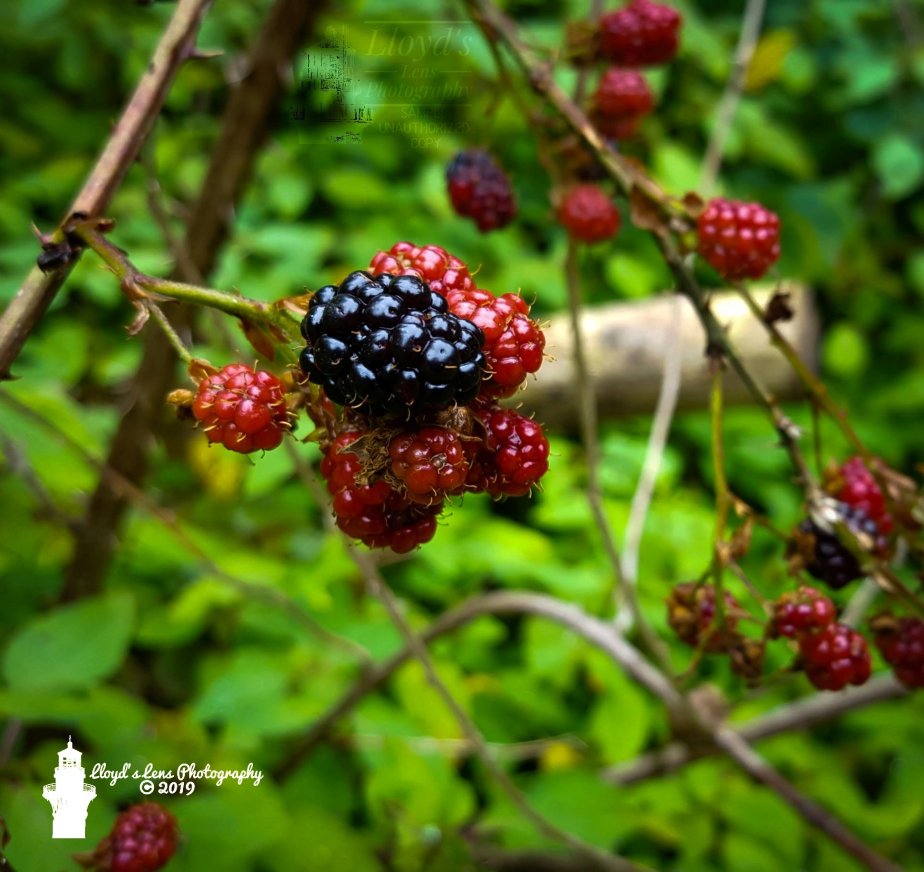
Hello Friends! Tonight’s feature image is titled “Hiker’s Delight” and is available for purchase by following the instructions at the bottom of the article.

Tonight’s Forage Friday is one that everyone should be familiar with. Brambles!

I have chosen to lump all of the various types under the umbrella of Brambles but they include, Loganberries, Boysenberries, Blackberries and Raspberries as well as dewberries. Most people know that these are all clusters of berries that grow on thorn covered canes. A few will even know that the easy way to tell the difference between a true blackberry and a black raspberry is that the raspberries normally have a cup shaped berry and are usually smaller. Tonight’s feature image is actually a Black Raspberry in my property that was storm damaged but fruited anyway.

Now, every country boy knows that the proper way to enjoy brambles is in the form of a fresh baked cobbler that is served warm with vanilla ice cream. This is to be enjoyed at a large table during a family meal and preferably on Sunday afternoon. 😉 This was always something that we looked forward to when I was a kid. Even today the sight of brambles growing on the edge of a field or some seldom traveled dirt road conjures up the memories of my grandma’s house and the smells of a home cooked meal. Back in those days the extended family wasn’t spread out across the globe. Every Sunday was like a family reunion.

There’s definitely an art to picking brambles. Long sleeves and gloves are common recommendations but I have to wonder if the person who wrote those recommend guidelines lived in the South. Brambles usually ripen during the hottest time of the year here. For me dealing with a few scratches on my arms is preferable to heat stroke. I have a long stick with a metal hook that I made from a broken sickle that has proven to be useful for pulling the canes closer rather than trying to work myself into a mass of thorns. The ripe berries come off with the slightest touch and sometimes it’s possible to just shake the cane over a bucket. Unless you’re making a wine from them you don’t want to fill the bucket too full or the berries on the bottom are crushed. The best harvest that I ever had came from a patch that had been trampled. I strolled into the middle of the broken canes and filled all my buckets in no time. I was pretty upset with whoever the other forager was for destroying such a large patch with little regard for the next guy when something happened that sent chills up my spine. My foot slipped a little and I looked down to find that I had stepped in bear scat! Needless to say that I decided not to confront the bear concerning it’s lack of etiquette.

A secondary harvest that most people overlook is the bramble leaves. Collecting the leaves and curing them out for teas. The real secret to any wild tea is the steeping time. About five minutes is recommended for brambles. Bramble leaves are rich in tannins and can become a little bitter if steeped for too long or in water that’s too hot. Herbalists do use a strong bramble leaf tea to treat certain types of diarrhea and the leaves have antimicrobial agents that is said to make them useful for treating certain infections. The leaf is also used for making a skin wash for acne. But as always, please remember that I am not a trained herbalist and that my Forage Friday posts are just talking points.

I have successfully transplanted wild brambles to a place closer to my home. They prefer partial sun and soil that gets plenty of water but that drains well. The wild varieties don’t really seem to be bothered by diseases but the presence of hickory, walnuts or pecans are a death sentence. Trees from the juglandaceae family secrete a poison that kills out the competition.

I have tried to provide a quick and simple start on foraging brambles and Friday has almost ended so I’m going to end the article here and make plans for buying some vanilla ice cream to go with the harvest on the edge of my yard.

Hello Friends and thank you for your support of my page. If you have enjoyed the photos or the writings please let me know by commenting and sharing my work on your social media. I also want to invite you to Follow Lloyds Lens Photography on Facebook

If you would like to Follow me on Facebook the web address is

https://www.facebook.com/aviewfromthelens/

If you’re enjoying my blog and don’t want to miss a post then you can sign up for email alerts on my website.

https://lloydslensphotographyllc.com/

Click here to visithttps://lloydslensphotographyllc.com/

Did you know that I also do portraits by appointment? If you’re interested in a portrait session either message me on Facebook or Use the Contact form. The YouTube link below takes you one of my slideshows.

https://youtu.be/FDcrY6w8oY8

Have you checked out the Zazzle Store?

I’m now using Zazzle to fulfil orders. What this means for you is a secure way to place an order, discount codes & a broader product selection! Simply message me on Facebook oruse the contact form on my websiteand tell me which image you want and I’ll reply with a direct link to where you can place the order.

Clicking on the photo takes you tohttps://www.zazzle.com/lloydslensphotos?rf=238248269630914251

Lastly, all of the photos and writings are my original work unless otherwise specified and are not to be copied or reproduced without expressed written permission from the photographer.

Thank you again for your support of my page!❤

Forage Friday # 13 Sassafras

Hello Friends! Tonight’s feature image is titled simply “Sassafras Leaves”. The image was produced specifically for this article and is not really as a “sales piece”. However, if you see an image on my blog that you would like to purchase just follow the instructions at the bottom of the article .

The warm humid air carries a sweet spicy aroma as I approach the small trees growing along the road. Because I live in rattlesnake country I use the hook on the end of my walking stick to pull the branches to me instead of wading through the weeds. Taking a bit of the fresh leaf and rubbing it between my thumb and forefinger releases even more of the aromatic oils. Sassafras has one of the most pleasant fragrances found in nature. To me it’s the strongest identifying quality of this very useful tree.

I suppose that my first experience with Sassafras is the preschool memory of my dad coming home from work with the root bark. I remember that he held it out for me to smell. Then he put it a pot of water that was simmering on the stove and the whole house smelled like warm root beer. That was late Fall and the memory of that experience is just as strong as it ever was. But today I have a different purpose for the sweet oils of the Sassafras tree. I plucked a few more leaves and began to crush them up in my hands. I rub the resulting liquid on exposed skin and tuck the bruised leaves under the brim of my hat. The fragrance helps hide me from the mosquitoes that lurk in the shade. Thanks to my grandfather for teaching me this trick while out caring for the cattle.

Sassafras is leaf was formally used for the flavoring in gumbo! Now, I have not been able to enjoy this one personally and gumbo from a commercial source must not contain Sassafras by law. In fact it’s banned from all commercial production due the risk of cancer from the essential oil. ( And yet Philip Morris can still sell cigarettes on every street corner. ) We haven’t been able to use it commercially since 1979. Before that root beer and root beer candy was made with natural extracts and real sugar.

These days this wonderful tree is still sold as an ornamental plant. The large purplish blue berries are a favorite of songbirds. I have to say that I’ve noticed that the drop in the bobwhite and drop in popularity of natural Sassafras flavored products seems to coincide. It’s worth propagating the tree just for the wildlife value alone.

The one commercial use that the FDA allows us to have is the exotic lumber value. Sassafras hartwood is considered to be very durable and is absolutely beautiful. As a forest owner you could probably do pretty well by producing a handful of timber sized Sassafras trees per year. A quick Google search turned up asking prices around ten dollars per board foot. So a rough value estimate of an average Sassafras wood 24 inches thick, 8 inches wide and 30 feet tall came out to around $6K per tree. ( This was a very quick and very rough estimate and it’s been 30 years since I actually had to estimate the value of timber so I am not positive about that estimate. ) Purists may not consider the commercial use of lumber to be foraging. To those good folks, I need to point out that foraging is using the resources of the land to feed yourself and others. Since $6k will buy a lot groceries it counts in my book. And if done right it will open up resources for renewal of the lower canopy to thrive and mature. And that estimate doesn’t really include the possibility of novelties made from pieces that a mill might reject such as lathe turned jewelry and bespoke canes.

Overall, it turns out that Sassafras has a lot to offer and we haven’t even considered the medical uses. ( Mainly because of the FDA ban ) I may revisit this one in the fall when I’m in the mood for a homemade root beer!

Hello Friends and thank you for your support of my page. If you have enjoyed the photos or the writings please let me know by commenting and sharing my work on your social media. I also want to invite you to Follow Lloyds Lens Photography on Facebook

If you would like to Follow me on Facebook the web address is

https://www.facebook.com/aviewfromthelens/

If you’re enjoying my blog and don’t want to miss a post then you can sign up for email alerts on my website.

https://lloydslensphotographyllc.com/

Click here to visithttps://lloydslensphotographyllc.com/

Did you know that I also do portraits by appointment? If you’re interested in a portrait session either message me on Facebook or Use the Contact form. The YouTube link below takes you one of my slideshows.

https://youtu.be/FDcrY6w8oY8

Have you checked out the Zazzle Store?

I’m now using Zazzle to fulfil orders. What this means for you is a secure way to place an order, discount codes & a broader product selection! Simply message me on Facebook oruse the contact form on my websiteand tell me which image you want and I’ll reply with a direct link to where you can place the order.

Clicking on the photo takes you tohttps://www.zazzle.com/lloydslensphotos?rf=238248269630914251

Lastly, all of the photos and writings are my original work unless otherwise specified and are not to be copied or reproduced without expressed written permission from the photographer.

Thank you again for your support of my page!