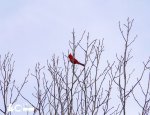
Hello friends! Tonight’s feature image is titled “Morning Visit 3920” and is available for purchase by the instructions at the bottom of the article.
A lone song rings out across the hill as stepped out for a breath of fresh air. I’ve come to call the male Cardnial that frequents my land “the Red King”. Like all male Cardnials he finds the highest perch he can for his song.
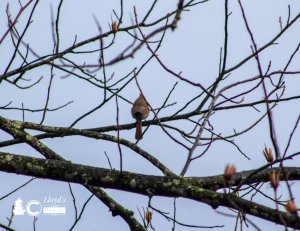
If you sit and actively listen to them his gives a short chirp between songs. He’s answering his mate in the lower branches.
Typically, female Cardnials stay in the lower branches.
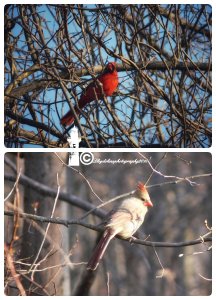
Male and female Cardnials stay in constant communication. The experts say that they actually develop local dialects.
Images are titled “Male and Female Cardnials 41318” and available as a set or separately.
Their language is sophisticated enough for the female Cardnial to actually give the instructions about what to bring back to the nest.
Male and Female Cardnials 31020
Cardnials mate for life and when the nest is active the female stays with the babies to ward off predators. So ordering takeout kinda makes sense.
The Red King calls a few minutes and sure enough an answer is heard coming from a thicket on the other side of the property and the Red King darts off to his queen. I’m betting that he stopped by the feeder to pick up some thistle seed on his way home. 😉
Hey Friends! Just a quick reminder that graduation will be here before you know it. Lloyds Lens Photography is available for portraits!!
This slideshow requires JavaScript.
Tobook me simply reach out using theContact Pageand we’ll set a date. If you’re within a 50 mile radius of Summersville West Virginia all travel fees are waived.
Hello Friends and thank you for your support of my page. If you have enjoyed the photos or the writings please let me know by commenting and sharing my work on your social media. I also want to invite you to Follow Lloyds Lens Photography on Facebook
If you would like to Follow me on Facebook the web address is
Did you know that I also do portraits by appointment? If you’re interested in a portrait session either message me on Facebook or Use the Contact form. The YouTube link below takes you one of my slideshows.
I’m now using Zazzle to fulfil orders. What this means for you is a secure way to place an order, discount codes & a broader product selection! Simplymessage me on Facebookoruse the contact form on my websiteand tell me which image you want and I’ll reply with a direct link to where you can place the order.
Lastly, all of the photos and writings are my original work unless otherwise specified and are not to be copied or reproduced without expressed written permission from the photographer.
Hello friends! Tonight’s feature image was taken specifically for this article. All of the photos found on my blog are my original work and are available for purchase by the instructions at the bottom of the article.
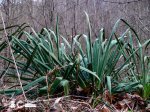
I have to admit that I was surprised to be able to keep Forage Friday going as steady as I have for this long. I knew that in the warm months that I could find plenty of plants to feature and that even the ones that I haven’t really paid attention to in the past that I could do a little bit of research and come up with something interesting to write about. I suppose that it just goes to show that God has provided all of our basic needs in abundance. But today was one of those days when I was down to wire for a forage plant when I spotted this one growing wild on the roadside bear my home. And what’s even better is that it came up in conversation organically a couple of days ago. Tonight’s plant is Adam’s Needle or Yucca as it’s known in other parts of North America.
Yucca isn’t really a native of the Appalachian Mountains. It was brought here by a previous generation as an ornamental plant. It’s bushy appearance and cold hardiness made it desirable for those who wanted something exotic in their garden. And it It’s still used in landscapes today. It’s actually a native of the Southwest if I’m not mistaken.
If cattails are the supermarket of the wetlands then Adam’s Needle is the supermarket of abandoned homesteads and sub desert areas.
The name comes from the single tall flower spike that shoots up from the center in the summer. This is the part that I’ve actually eaten myself. The pedals of the flowers can be eaten raw but you need to get them when they’re freshly opened or they turn bitter.
The root is also edible and high in carbohydrates which is one reason that I’ve never tried it myself. (As a type 2 diabetic I really try limit the carbs so that I can avoid meds. ) Sometimes you can even find the roots in the produce section of your local grocery store depending on the region.
One of the survival tricks that I learned was to make soap from the root by cutting it into small chunks and dropping them into a bottle with little water. It’s not really soap but a compound called saponin which acts like soap and is even antimicrobial.
The leave can also be used to make soap but where they really come in handy is making cordage. A single leaf blade can be used to make fairly strong string without much work but it’s much better with son e processing.
Here’s a closeup of the fibers in Adam’s Needle
The process to get to the fibers is pretty simple. Cut a leaf near the base of the plant but watch out for the single thorn on the very tip of the leaf. Depending on your purpose for the cord you might have a use for the thorn because with a little care it can be function as a pre-threaded needle for sewing. An emergency repair for a torn jacket or pants can make a difference in the quality of life for someone who is without any other system of support. The best way to process it to lay the leaf on a flat surface and gently pound it with a heavy branch. You could use a smooth rock if you have one but a rock with sharp edges could cut the long fibers and create more work. The goal here isn’t to make mince meat out of the leaf but to separate the fibers from the pulp. The byproduct of the pulp can still be used for soap when fresh and because it kills microbes it might be good idea to put it on any minor wounds you might have. When you’re done with the pounding simply use the back of a single edge knife or a stick with a flat side and gently scrape the pulp away from the fibers. The fibers should remind you of a lock of hair at this point. They’ll be strong enough for sewing but if you are using them for rope then you’ll need to twist them. The way I do it is to roll the fibers on my thigh until they’re so tight that they twist back on themselves. Then double the rope and help that action by rolling in the opposite direction on your thigh again. There’s plenty of video on YouTube that shows how this is done and as it happens you add length by twisting in more fibers. Once you gave your cordage it can be turned into nets, baskets and even sandals by weaving.
So here’s one plant that you might find wild or you could even get one from the lawn and garden store and plant as both landscape and emergency use in tough times.
Hey Friends! Just a quick reminder that graduation will be here before you know it. Lloyds Lens Photography is available for portraits!!
This slideshow requires JavaScript.
Tobook me simply reach out using theContact Pageand we’ll set a date. If you’re within a 50 mile radius of Summersville West Virginia all travel fees are waived.
Hello Friends and thank you for your support of my page. If you have enjoyed the photos or the writings please let me know by commenting and sharing my work on your social media. I also want to invite you to Follow Lloyds Lens Photography on Facebook
If you would like to Follow me on Facebook the web address is
Did you know that I also do portraits by appointment? If you’re interested in a portrait session either message me on Facebook or Use the Contact form. The YouTube link below takes you one of my slideshows.
I’m now using Zazzle to fulfil orders. What this means for you is a secure way to place an order, discount codes & a broader product selection! Simplymessage me on Facebookoruse the contact form on my websiteand tell me which image you want and I’ll reply with a direct link to where you can place the order.
Lastly, all of the photos and writings are my original work unless otherwise specified and are not to be copied or reproduced without expressed written permission from the photographer.
Hello friends! Tonight’s feature image is titled “Boone Park Sunset 21720a” and is available for purchase by the instructions at the bottom of the article.
As the clouds break from days of rain the new found light lingers on the landscape. The mighty Kanawha River is still swollen with the runoff but otherwise peaceful. I decided to detour down to Daniel Boone Park on my way home to try and find a few ducks or geese to photograph but they were long gone as the dusk crept over the river. Gazing downstream I see the contrails catching the sun and think about how they look like golden threads in the tapestry of the sky. As my eyes follow those lines to the horizon I find the pool of color that erupts from the broken clouds and spills into the river. For me, mid February to mid March is my season of sunsets. It’s when I get the most opportunity to catch God painting the sky with light. As watched the light fade from view through my lens I felt the calling of my big blue truck telling me to hurry back up the pathway before the light is completely gone. As I near the top of the bank I cast my eyes back to river just in time to see the sunset fade into shadows. A few clicks of the remote and Big Blue opens his eyes to light up the way and bring me in. It’s time to return to my mountain and leave the valley of lights behind.
Hey Friends! Just a quick reminder that graduation will be here before you know it. Lloyds Lens Photography is available for portraits!!
This slideshow requires JavaScript.
To book me simply reach out using the Contact Page and we’ll set a date. If you’re within a 50 mile radius of Summersville West Virginia all travel fees are waived.
Hello Friends and thank you for your support of my page. If you have enjoyed the photos or the writings please let me know by commenting and sharing my work on your social media. I also want to invite you to Follow Lloyds Lens Photography on Facebook
If you would like to Follow me on Facebook the web address is
Did you know that I also do portraits by appointment? If you’re interested in a portrait session either message me on Facebook or Use the Contact form. The YouTube link below takes you one of my slideshows.
I’m now using Zazzle to fulfil orders. What this means for you is a secure way to place an order, discount codes & a broader product selection! Simplymessage me on Facebookoruse the contact form on my websiteand tell me which image you want and I’ll reply with a direct link to where you can place the order.
Clicking on the photo takes you tohttps://www.zazzle.com/lloydslensphotos?rf=238248269630914251Lastly, all of the photos and writings are my original work unless otherwise specified and are not to be copied or reproduced without expressed written permission from the photographer.
Hello friends! Tonight’s feature image is titled “Small Wonder In Winter” and is available for purchase by the instructions at the bottom of the article.
Disclaimer: This is a plant that I’m just now getting to know. That means that it’s very likely that I could be mistaken about some of the information covered in the article. But that’s also why I always advocate that you do further research before trying any wild plant.
The cool crisp air is envigoreating as I head out to see what I can see. The dry leaves crunch under my feet as carefully stride to my little quiet spot on the edge of my property. The spot has become my sanctuary of the past few years and I’ve truly enjoyed stepping out at different times of the year to observe the minor changes in the landscape. On one particular day I spotted the green leaves creeping over the leaf litter in December. I probably should have noticed it a long time ago but I didn’t. It looked like something that I should recognize but I couldn’t quite place it. So I waited and I watched to see what the tiny leaves developed into. But even after several weeks of unseasonably warm weather the little plant didn’t grow. I looked through all my reference books and it seemed to look like everything with a small compound leaf. So I finally turned to the West Virginia Native Plant Society on Facebook for a little help with the ID. It wasn’t long before I got a reply and a direction for research. The plant turned out to be Polemonium Reptans.
Now there’s a reason why I use the scientific name for tonight’s post. Like most plants Polemonium Reptans is known by a number of common names including, Creeping Jacob’s Ladder, Jacob’s Ladder and False Jacob’s latter. It’s even known by the name Greek Valerian.
That’s where the confusion comes in. Because Polemonium Reptans has a bunch of cousins and all are commonly called “Jacob’s Ladder”. And when you are interested in the food or medicinal qualities of a plant different species within the genus might have different qualities both beneficial and undesirable.
Also, the common name “Greek Valerian” is a little deceptive because true Valerian is a completely different family of plants with sedative properties while “Greek Valerian” seems to be more of an anti-microbial herb. In fact Polemonium Reptans is also called “Abscess Root” for that very reason.
So tonight I have a start on a plant that has caught my interest but one that I have not really researched in depth. Partly because I seem to be at the Easternmost extent of its range. I found tonight’s feature image growing beneath yellow birch and a magnolia on an almost vertical Northeastern slope. The research so far suggested that it likes stream banks and rich soil.
The medical uses I’ve found are that it’s anti-inflammatory, anti-microbial and promotes sweating. ( I also found it listed as “sweatroot” ) The internet also says that it is seldom used. That could be because it’s also described as not tasting very well or because there’s so many better options. So I’m going to do more research on this one and give you a part 2 in the spring when this little Phlox ( yes, I found another name ) comes into a beautiful bloom.
Hello Friends and thank you for your support of my page. If you have enjoyed the photos or the writings please let me know by commenting and sharing my work on your social media. I also want to invite you to Follow Lloyds Lens Photography on Facebook
If you would like to Follow me on Facebook the web address is
Did you know that I also do portraits by appointment? If you’re interested in a portrait session either message me on Facebook or Use the Contact form. The YouTube link below takes you one of my slideshows.
I’m now using Zazzle to fulfil orders. What this means for you is a secure way to place an order, discount codes & a broader product selection! Simplymessage me on Facebookoruse the contact form on my websiteand tell me which image you want and I’ll reply with a direct link to where you can place the order.
Clicking on the photo takes you tohttps://www.zazzle.com/lloydslensphotos?rf=238248269630914251Lastly, all of the photos and writings are my original work unless otherwise specified and are not to be copied or reproduced without expressed written permission from the photographer.
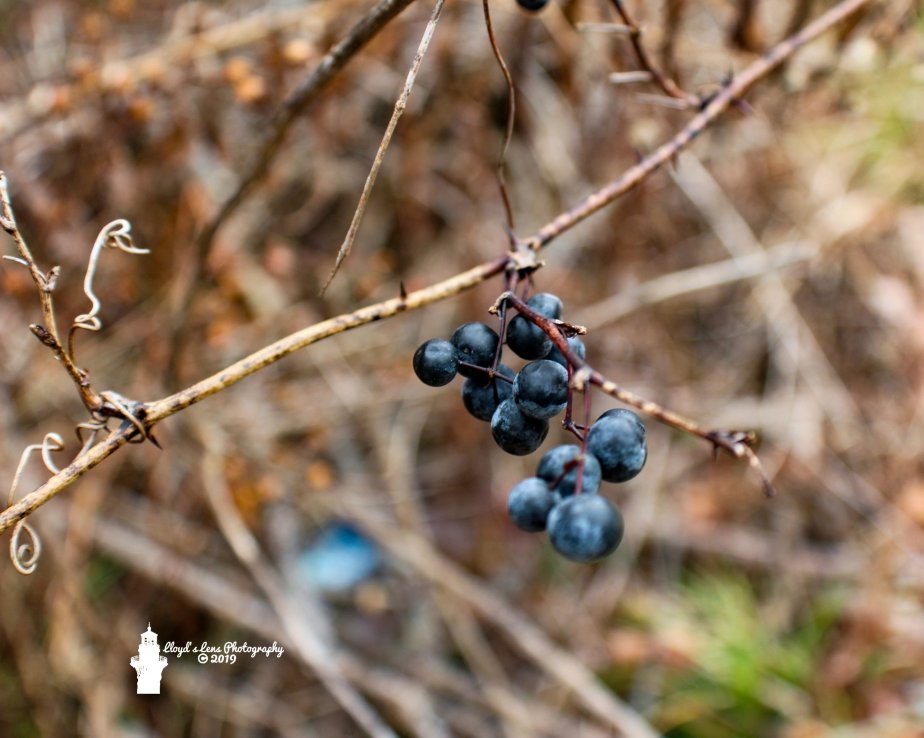
Hello friends! Tonight’s feature image is titled “Greenbrier Berries 122719” and was taken specifically for this article. All of the photos are my original work and are available for purchase by the instructions at the bottom of the article.
Although I chosen to use the cluster of greenbrier berries as tonight’s feature image I wasn’t really able to find a wide variety of references to the food value of the berries themselves. Greenbriers produce edible roots, shoots and leaves and while the berries may not be poison they do contain a large seed and I’m not sure what th e flavor of the berry might be like.
I have never taken the time to sit down and watch the old movie “Calamity Jane” but I understand that’s where the quote “Make mine a sarsaparilla” came from. In the 1800s Charles Elmer Hires made his mark on American culture with Root Beer which was often referred to as “sarsaparilla” but actually didn’t contain any of the plant that gives real sarsaparilla it’s flavor. Instead he used a mixture of birch oil and Sassafras to create his brew. It was a huge success until 1960 when the US Food and Drug Administration banned the sale of Safrole. (The substance that gives Sassafras it’s flavor and is also found in black pepper as well as nutmeg.) However, in other countries the true Sarsaparilla plant which has been used since the 16th century continued to be the soft drink of choice. That plant is one of about 300 species of greenbrier. And that brings me to tonight’s post.
As I researched the article I learned that greenbrier based soft drinks widely available and very popular in other countries. So much so that I’m a little surprised that Americans haven’t been growing smilax ( The greenbrier genus) commercially ourselves.
In the Spring, the soft new growth of the vine is free of thorns. To harvest the new shoots simply locate the uppermost thorn and begin flexing the stem while slowly working your way to the top. When you reach the point where the woody fibers end the tip will naturally break off in your hand. The shoot is tender enough to eat raw right there on the spot. It’s flavorful too. I have enjoyed this myself and it tastes a little like asparagus. It’s also fun to joke with those who don’t forage about being tough enough to chew on briers. I’ve not tried them steamed or boiled but they’re said to be excellent when cooked and buttered.
Next is the leaves. Young leaves like the stem are tender enough to eat raw and go great in a “wild child” salad. They can also be cooked like spinach and served as a pot herb.
But the real harvest is the root crop. Smilax roots are fibrous and those fibers need to come out. It’s a little bit of a process but once you dig up the root it should be peeled like a potato and crushed under water. Allow the starch to settle out in the bottom of the container and gently pour off the water with the floating fibers. The starch on the bottom can be used like flour and can be used immediately or dried and saved for later. This powder is kinda special among starches. By adding a tablespoon of the dry red powder to each cup boiling water you can make a nice jelly. Or by diluting it and chilling it you get the aforementioned soft drinks ( minus the carbonation). I’m guessing that either product will require sweetening. The starch can also be added to soups and stews as a thickening agent.
I have not been able to confirm that greenbrier root contains the Safrole like nutmeg, back pepper and the banned sassafras but if not then it just a wild forage plant but a potential commercial crop for niche markets.
The most popular type of Sarsaparilla is the Jamaican variety but the best variety in North America is the Bull Brier. From my experience it has the fewest thorns and the best flavor.
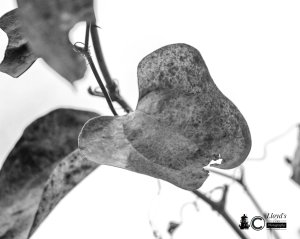
The late Fall leaves of a Bull Brier showing the different shapes of the leaves.
Hello Friends and thank you for your support of my page. If you have enjoyed the photos or the writings please let me know by commenting and sharing my work on your social media. I also want to invite you to Follow Lloyds Lens Photography on Facebook
If you would like to Follow me on Facebook the web address is
Did you know that I also do portraits by appointment? If you’re interested in a portrait session either message me on Facebook or Use the Contact form. The YouTube link below takes you one of my slideshows.
I’m now using Zazzle to fulfil orders. What this means for you is a secure way to place an order, discount codes & a broader product selection! Simplymessage me on Facebookoruse the contact form on my websiteand tell me which image you want and I’ll reply with a direct link to where you can place the order.
Clicking on the photo takes you tohttps://www.zazzle.com/lloydslensphotos?rf=238248269630914251Lastly, all of the photos and writings are my original work unless otherwise specified and are not to be copied or reproduced without expressed written permission from the photographer.






 LLOYD'S LENS PHOTOGRAPHY LLC