The Little Brick Church

Tonight’s Feature Image is Virginia’s Chapel in Cedar Grove West Virginia. The link will take you to the Wikipedia article. The article is short but states that the Church (also known as the Little Brick Church) was built in 1853 and used by both sides of the Civil War And that’s in the national registry of historic places. But, is that all that history is? A few facts and dates can’t tell the whole story. I often pass through when a wedding is taking place and the Little Brick Church is all decorated. I see friends and family gathering on the walkway and occasionally see someone taking care of the cemetery on the other side of the chain link fences. I have to wonder about the memories that were made here when the lot was more open and cemetery less full. Back in days when the roads were not paved. I imagine that the fields were open and picturesque. The church was full of live music and joyful noise. I imagine that a few sour notes were sung as the rest of congregation gave each other “that look” and continued to worship God in earnest.

The church wasn’t fully completed until 1912. A full generation after the Civil War. I don’t think that was a coincidence. It could only be completed those who had put away their harsh feelings about the past and fully committed themselves to becoming one family. And that brings me to main thought for tonight. If we want to complete the work set before us then we have to put aside the outside world and come together as one people. I’m speaking mostly to my brothers and sisters in Christ but this concept goes for secular organizations as well. Time on this earth is finite. Effective time is in even shorter supply. Don’t waste a second of it. Find some middle ground and complete the tasks at hand.

Hello Friends! If you have enjoyed the photos or the writings please let me know by commenting and sharing my work on your social media. You can also follow Lloyds Lens Photography on Facebook.

Thank you for visiting!
Some Memories Of My Grandfather & A Special Sight On My Daily Commute

Out of all the jobs I’ve worked I think “Rancher’s Assistant” was my favorite. My Grandfather McClung made it seem easy. As a pre teen my responsibility was to count the cattle a couple of times a day and check the fencing for any slack in the barbed wire. Even though I haven’t been involved with cattle for many years I still have an urge to take a head count anytime I see cows.

I miss the long walks out to repair a hole in the fence line. It was the conversations and time with my Grandfather that made it special to share work. And then there was O’l Count. My grandfather’s cattle dog. When it was time to rotate the pastures (moving the cattle from one paddock to the next) we would open up a gate and tell O’l Count to bring the cattle. Without fail he would gather the herd and drive them through.

Occasionally a mother cow or the bull would resist but the dog was way to quick and agile for what seemed like a slow motion attack. He would dodge to the side and circle back around to nip at their heels. Most of the time this wasn’t a requirement. We always fed the cows something special when we moved them and when they saw the gate open they would come running like pets.

The cattle my Grandfather raised didn’t look like the one in the feature image. They looked like the one below. They were Hereford cattle.

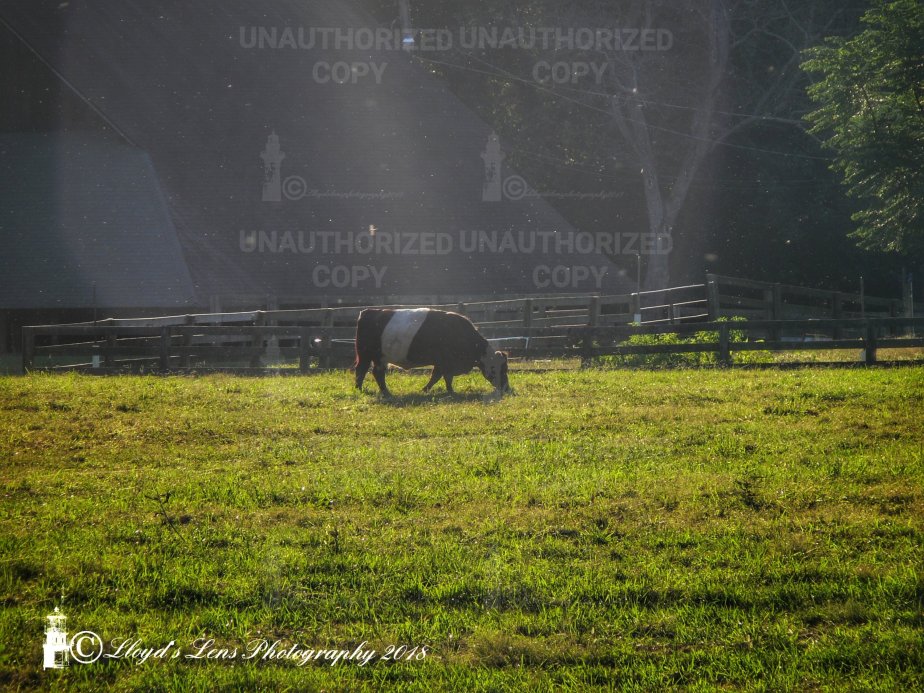
I believe that it’s a Lakenvelder bull in the feature image. The Lakenvelder is a dairy cow and it seem that the milk would be perfect for dipping Oreo cookies. 😉

Needless to say that when I pass by this herd on my way to my day job I have a nostalgic reaction to seeing them even though they’re not the breed I’m used to. Believe or not this breed is an endangered species. According to Wikipedia there are less than 300 of these cows in the United States and less than 1000 worldwide. Which of course makes it an extra special sight in the Appalachian Mountains.

Hello Friends and thank you for your support. If you have enjoyed the photos or the writings please let me know by commenting and sharing my work on your social media. Please also consider following me by signing up on my Home page or following Lloyds Lens Photography on Facebook.

Visiting A Monarch In The Fading Sun

Softly the brightly colored wings float in on the warm breeze. The sweet smell of water mints mingles with the Virginia Bonset and Goldenrod. The sun is low in the marbled sky and I let my big blue truck drift to a halt. The Monarch Butterfly has been playing on edge of the parking lot all day. Gently it flutters from flower to flower sipping the nectar. I roll the window down and raise my camera into the ready position. The Monarch teases me as it feeds by fluttering it’s wings quickly. Further up into the bush a mockingbird gives it’s long song. The shutter snaps at just the right moment as the Monarch pauses. A peaceful feeling washes over me as I preserve the mountain beauty in my lens. Soon the sweet scent of all the bloom will fade and the warm breeze will be chilled by the changing seasons. But, I will have this moment to warm my heart and this beauty to sooth my eyes against the coming grey. With my task complete I start the motor and turn my big blue truck towards home.

Where Are The Mountains Moving To?

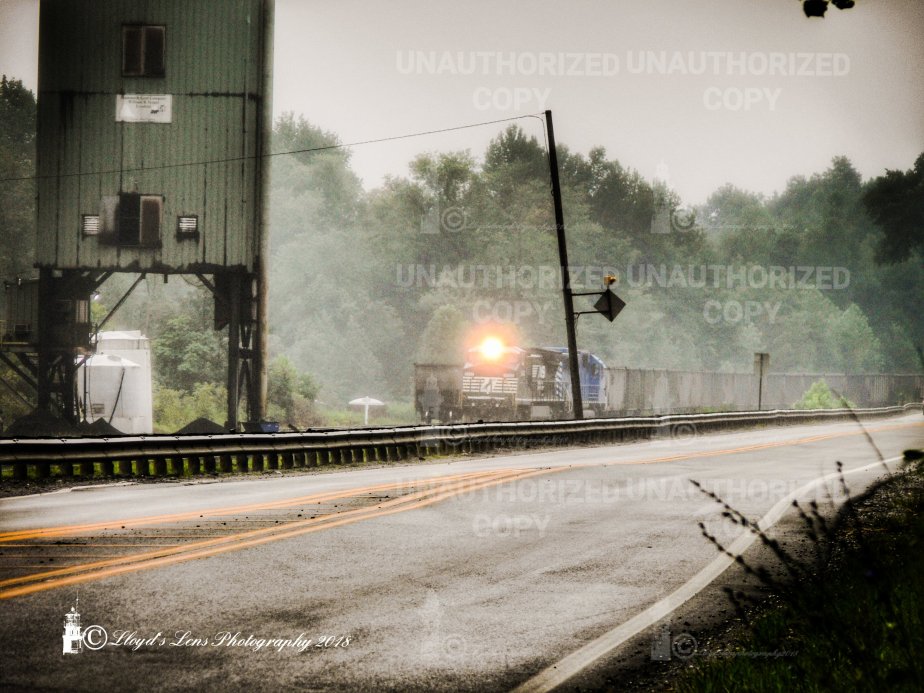
A light breaks through the morning mists as if it is plowing a pathway for travel. The long mournful sound of horn in combination with the thunder of wheels proceeds the screeching of the brakes as the train pulls into the tipple. I ease my big blue truck into the wide spot near the berm. A mountain is waiting to be loaded onto the train and moved to the power plants and steel mills. If the miners are the men who pull light out of the darkness then the railroad workers are the men who move mountains.

One of local engines CSX 7979 was recently spotted in California by my fellow blogger Russel Ray. Russel is real train buff who was able to track CSX 7979 back to Huntington West Virginia. I never really expected that any of our trains would be found that far West!

I suppose that it shouldn’t surprise me. Our coal goes into the grid as electricity and into the iron that becomes steel. It’s almost as if there is a little piece of our mountains in almost everything that is either made from steel or uses electricity. Look around. You probably have a piece of Appalachia in your home too.

She Works Best Alone

The late summer sun beams down into an abandoned pasture. The Ironweed is tall and tipped with bright purple flowers that seem to resemble a fireworks display frozen in mid burst. The plants sway back and forth as if the breeze is shaking them but there’s no wind today. As I step closer I can hear the constant hum of thousands of tiny winged workers. The bees are too busy collecting the pollen to bother with chasing the photographer. However, I don’t to encroach to far into their workspace. I walked up to the closest flower and the huge carpenter bee doesn’t really react to lens hovering just above her head. She checks each bloom one at a time mentally keeping notes about which ones will be ready tomorrow. Unlike the honeybees she is a solitary bee. She loves her neighbors but avoids the hustle and bustle of a hive. She has only her own brood to care for and she likes it that way. As she gave the flowers one last double check she moved into the right position for me to snap the shutter. I take a few more shots so that I can choose the best ones to keep. Then it’s time to let this working girl get back to business and I take my big blue truck to the next destination.