
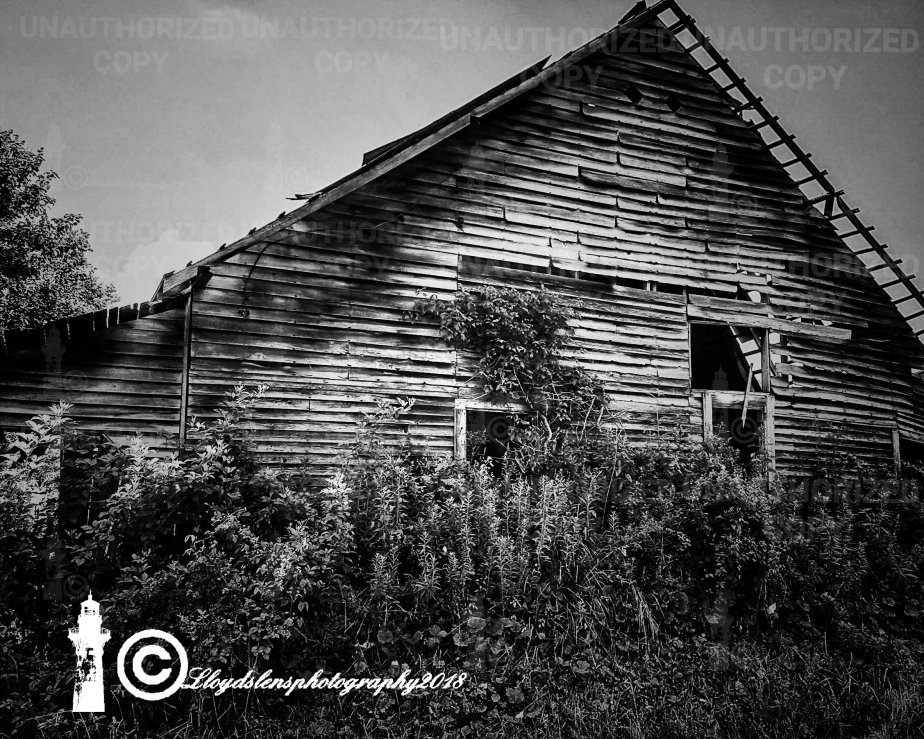
What is it that we love about very old things? I like nothing more than stumbling upon an old well weathered piece of wood or a rusty hunk of iron. Last night I talked about God’s perspective of time and how time carries us along as it flows. Tonight I’m thinking about our perspective. As time pulls us ever closer towards a destiny we cannot see clearly we can only measure the progress by looking back. Those things were once shiny and new now serve as landmarks. The old rusted trucks, crumbling stone and this old barn are like anchors that help us navigate the raging river of time. It’s even better if there’s a personal connection with the object. I have to wonder if anyone ever passes this barn and relives a special moment? Was there a first kiss that happened here? Was this the place where a spark grew into true love and then into a family? Was this the place where a parent answered a child’s important questions about life’s mysteries while doing the daily chores? Did a grandparent tell stories about when the parent was a kid? Do these stories still echo across the river of time? Yes. I think that they do. These very old things are the sentinels of memories that are still being made today.
Tag: Appalachian history

The Providence Of God & Walking With My Grandfather
Some of my most cherished memories are the long walks with my grandfather. He was World War Two veteran who walked with a cane due to shrapnel that was embedded in his leg but that never seemed to slow him down. He would come over to our little house trailer which was next door to his house and invite me to help him check on the cattle. He was also a survivor of the Great Depression and on our walks he would teach me about the things that they used to do to stretch the budget. One their best resources was the wild edible plants that are found in abundance in Appalachia. Pictured here is Chicory. All parts of the plant are edible. The leaves are eaten as a salad green and the roots are roasted and then ground into a coffee substitute. ( no caffeine). The blue petals if Chicory are a natural litmus test. When exposed to an acid they change from blue to red.
In the background of the image is Queen Anne’s Lace. ( the white flowers). Now, you have to be careful about collecting it because there’s also poisonous look-alikes such as hemlock. Queen Anne’s Lace usually has one tiny little blood red flower in the center of all that white. How’s it used? Well, I’m pretty sure that most of the world already knows because it’s simply a wild carrot. The root doesn’t really look like what you buy in the store or raise in your garden. It is small, white and kinda bland. But, it is a carrot none the less.
Most people look at the plants that grow without any help from humans and all that they see are weeds but I see the province of God and hear the voice of my grandfather.

Spanning The Gap
I have been convinced that nothing is impossible with enough planning and effort. I remember that long winding road through the mountains before they built the New River Gorge Bridge. The road was barely wide enough for one vehicle. I also remember the naysayers who claimed that the construction would never be completed and that the span was way too far. I think several people died building the superstructure but I couldn’t find a statistic. The completion of the bridge was monumental. It erased a large portion of the isolation of my area and opened up a lot of economic growth.
Sometimes we as humans have a tendency to isolate ourselves. It might take a monumental effort to bridge the gap between ourselves and others but the effort to bring us together opens up opportunity for something wonderful.

The Cheylan Railyard
Tonight’s image is the railyard at Cheylan West Virginia. If you look closely at the background you can see one of our coal tipples. The coal comes down the river in huge barges and is offloaded to the tipple where it’s moved by conveyor belt into the train. It’s some of the most dangerous work in the mining industry. My whole life I’ve heard stories about workers stepping between two rail cars at the wrong moment. The large piles of coal have been known to collapse and bury men alive. I know that coal energy is controversial in the world today but it is our main energy source in a large portion of the world. Here in West Virginia coal lights our homes, cooks our meals and powers our internet connection. It even powers our electric vehicles. Through the paychecks paid to the miners coal feeds families whose members have never set foot in a mine. (Every mining job supports between 3 and 5 others. ) It all centers on hubs like you see here and the workers who risk it all to pull light out of darkness.

Capturing A Dragon
The ancient Chinese told how dragons might be responsible for storms. The Aztecs had Quetzalcoatl. But the old timers in the eastern part of West Virginia told stories about the Snallygastor. A dragon in the New World. Even though the feature image shows a dragon-like impression in the texture of the clouds I’m not quite ready to lay responsibility of a storm on the existence of a “fearsome critter”. But it does seem to fuel the imagination. I can imagine a grandfather type character looking out from the shelter with children on his knee telling them all about the dragons as the storms pass. The story always has a happy ending and the children become so enthralled by the tale that they forget about the fear of thunder and lightning outside.
 LLOYD'S LENS PHOTOGRAPHY LLC